Created by the Kawaii Vibe editorial team. Our named style desks are editorial personas. Product details and availability can change.
Short answer: pick one checkerboard item, keep everything else plain, and make sure the check is a different size and shade from anything else you're wearing. That is how checkerboard outfits look styled instead of costume-y. The racing flag effect usually comes from too much high-contrast black and white in too many places at once.
This guide walks through scale, colour, placement and proportion, then gives you specific one-check outfits you can copy or adapt. You'll also get a way to compare options, the common mistakes, and a checklist to run before you leave the house.
Everything here is styling advice from Alex · The Alternative Desk, an editorial voice, not a personal testimonial. Product mentions are optional ideas from our range, and we only use the details listed on each product page.
The one-statement rule, explained
A checkerboard is already a loud graphic. Two squares side by side create strong contrast, and the eye locks onto it. When you wear it twice, the eyes bounce between the two spots and the outfit starts to feel busy.
There is one exception worth knowing: a tiny accent can sit next to a big statement piece if it's clearly smaller and quieter. Glasses with a check pattern on a plain outfit count as the statement. Glasses plus a check skirt is probably two statements. We'll come back to that in the pitfalls section.
So treat the check like a bold lipstick. One place, everything else supports it. That might be a skirt, a bag, a belt or a cardigan. The rest of the outfit should be solid colours, plain textures and simple shapes.
Scale: big squares, small squares, and what they do
Scale changes the mood more than colour does. Large squares, about palm-sized or bigger, feel graphic and bold. They read as a deliberate print and work well on a single piece like a skirt or pants where the pattern has room to breathe.
Small squares, around thumbnail size, start to blur from a distance and read more like a texture. They are easier to wear near the face and sit better on accessories and knits.
Medium squares are the tricky middle. They can look like a tablecloth on a wide piece or a flag on a fitted one. If you're unsure, hold the item at arm's length in the mirror or imagine the outfit from across a room. If you can still count the squares, it's a loud print. If you can't, it's calm.
Rule of thumb: the bigger the check, the plainer the rest of the outfit should be.
Colour: black and white versus everything else
Classic black and white has the highest contrast, which is exactly why it can tip into racing flag territory. It works best when the surrounding colours are neutral and flat, like grey, navy, cream or washed denim.
Softer pairings lower the volume. Brown and cream, black and charcoal, or a coloured check with white all feel less intense because the contrast between squares is smaller. If you want checks without the drama, colour is your friend.
A coloured check also lets you pull one shade into the rest of the outfit. A purple check, for example, looks intentional with a plain lilac or black top. A red check looks sharp with white and denim.
Keep to a simple count: the check plus no more than two other colours. That keeps the outfit looking planned.
Placement: where on the body the check should sit
Where you put the print decides how the outfit reads. Checks on the lower half, like a skirt or pants, anchor the look and keep attention at hip level. Checks on the upper half, like a cardigan, frame your face and shoulders. Checks at the waist, like a belt, are a thin line that adds detail without taking over.
Bags and glasses sit at the edges of an outfit. They add the print without changing your silhouetteThe overall shape an outfit creates, from fitted to loose and layered., which makes them the lowest-risk way to try the look.
Think about where you want people to look. A bold check on a skirt draws the eye down. A cardigan pulls it up. If you want a balanced outfit, put the check on one half and keep the other half completely plain.
Avoid placing checks at two points on the same vertical line, such as glasses and a check top. Spread them out or, better, stick to one.
Outfit 1: the pleated skirt with plain basics
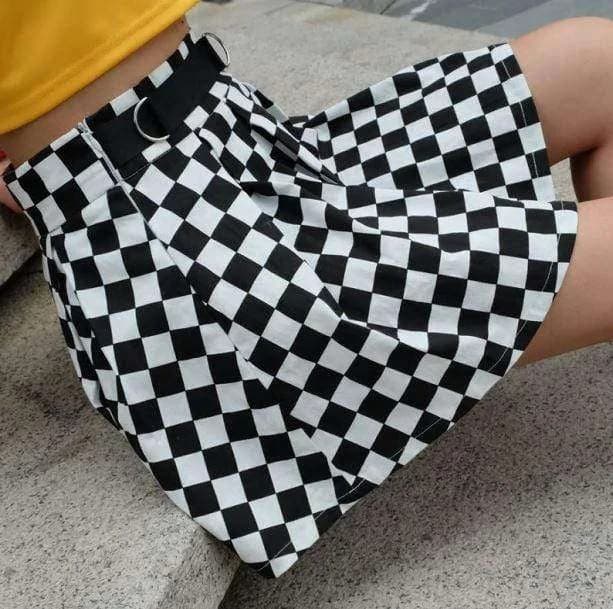
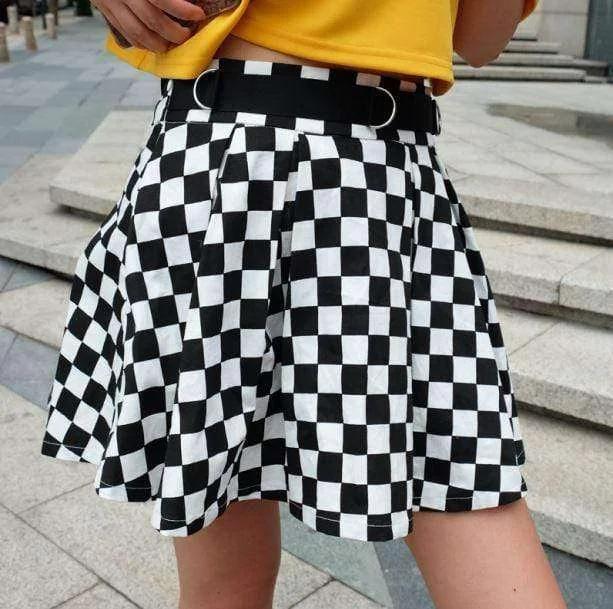
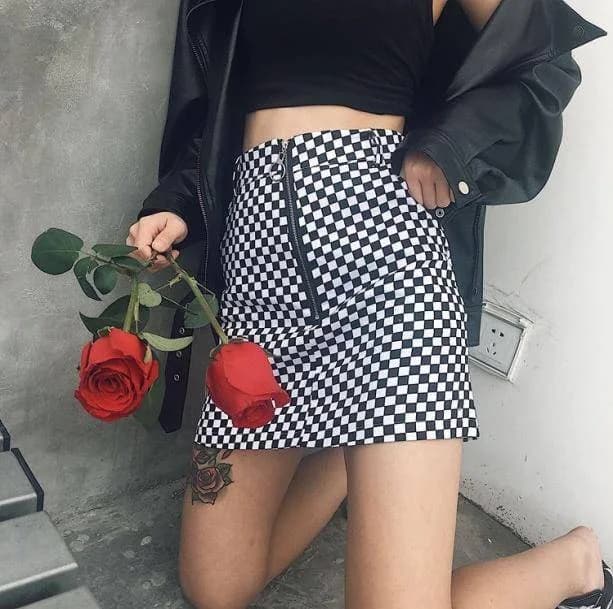
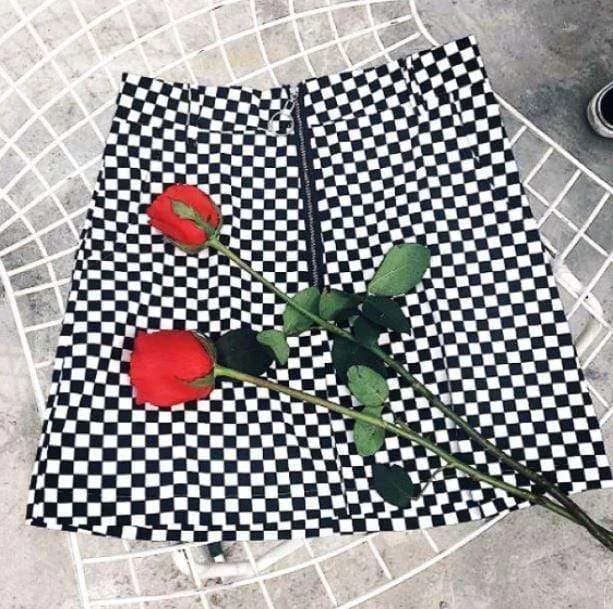
Start with the Checkerboard Skirt, listed in spandex and cotton, in sizes S, M and L. The structured cut pairs naturally with casual basics, giving a crisp geometric finish to everyday outfits.
Pair it with a fitted plain tee in white or black and a pair of simple trainers. The skirt is the only print, so the tee should be as quiet as possible. Tuck the tee in or half-tuck it to define the waist and show the skirt's shape.
Why it works: the skirt anchors the pattern, the top stays solid, and the shoes stay neutral. Proportion-wise, a fitted top with a structured skirt is a balanced shape.
Adapt it: swap the tee for a thin knit when it's cooler, or add a plain jacket. Keep outerwear solid so the skirt stays the focus.
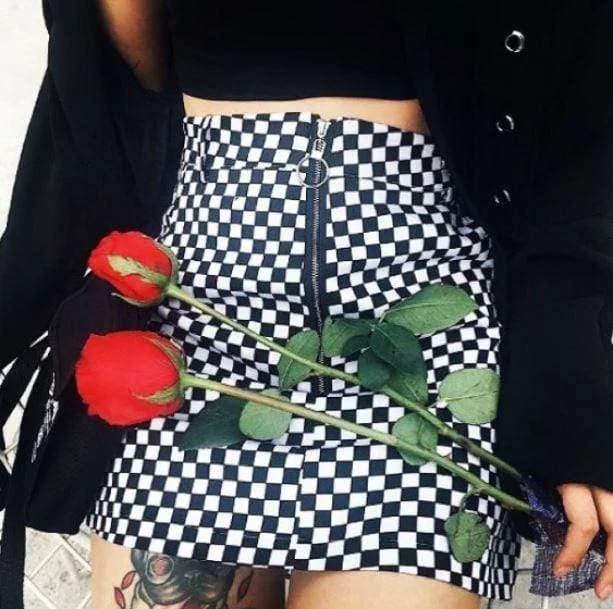
If you like a similar shape in a different layout, the Black And White Checkerboard Skirt is listed in cotton and polyester, in sizes S and M. Check the size options before you decide, since the two skirts offer different ranges.

Outfit 2: purple checkerboard pants as the only colour
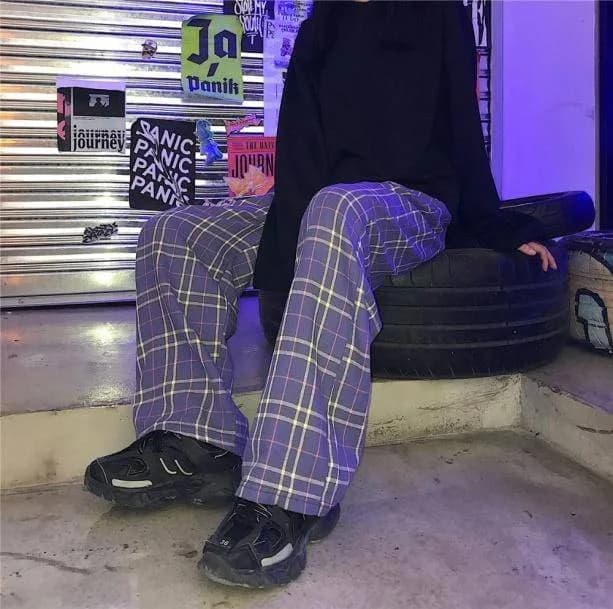
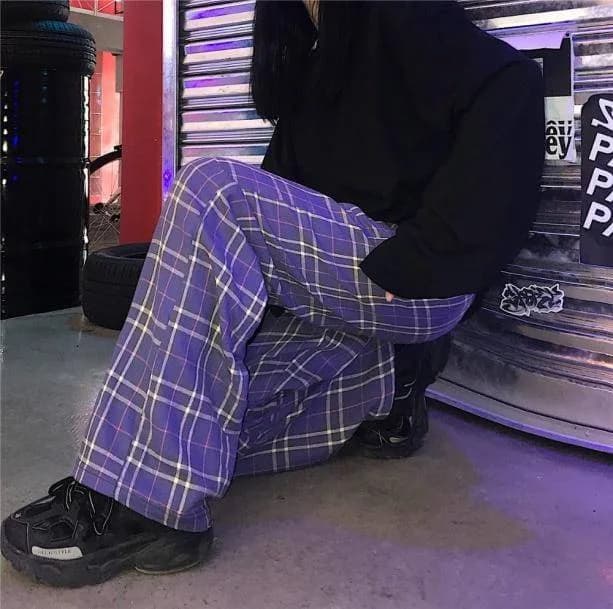
The Purple Checkerboard Pants are listed in cotton, in sizes M and L. Because they carry colour as well as pattern, they do a lot of work already.
Keep the top simple: a plain black, white or grey top, tucked or cropped at the waist. If you want to echo the purple, do it with something small and flat, like a plain lilac layer, rather than a second pattern.
Why it works: pants cover more area than a skirt, so the print dominates. That means everything else must step back. Neutral shoes and a plain bag finish it.
Adapt it: for a relaxed day, a plain hoodie and chunky trainers. For something sharper, a fitted top and simple boots. In both cases the pants stay the only pattern.
Note that the product page lists delivery time as 15 to 35 days, so check that against any date you're buying for.
Outfit 3: a cardigan on top, plain below
If skirts and pants feel like too much, put the check on your top half. The Y2K Checkerboard Cardigan is listed as 85% acrylic and 15% viscose, in brown or black, one size.
Wear it open over a plain white or black tee with straight dark jeans or a plain mini skirt. The brown option gives a softer, warmer look. The black option is closer to classic monochrome.
Why it works: a knit softens the print, and the open front breaks the pattern up with a plain stripe of tee down the middle. That reduces the flag effect even with a high-contrast check.
Proportion tip: a cardigan with a looser fit looks best with a closer-fitting bottom half. If the cardigan is roomy, keep trousers or skirts streamlined.
You can browse more checked pieces like this in the Checkered Aesthetic Clothes collection, which is a good place to compare different shapes before choosing.

Outfit 4: accessories-only checks for a quiet start
If you want to test the idea without committing to a whole garment, make an accessory your single check. Plain jeans, a plain tee and a plain jacket make a blank canvas.
Option one is the Checkerboard Belt, one size, worn through the loops of plain denim over a tucked tee. It is a thin line of pattern at your waist. Option two is the Red Checkerboard Belt, listed as canvas, 135 cm long, which gives you a red accent against denim or black.
Option three is the Checkerboard Pattern Glasses, offered in black, red and pink. They put the print right at face level, so keep your top and bottom plain and let the frames do the talking.
Pick only one of these per outfit. A belt and glasses together turn a hint into a theme.
Why it works: small areas of print feel playful, not overwhelming, and they're easy to swap in and out of outfits you already own.
Outfit 5: bag and trainers for the everyday route
For daily wear, the easiest place to put a check is on the bag. The Checkerboard Backpack is listed as polyester with oxford as the main material, with a capacity range given as below 20 to 35 litres, and dimensions of 32 cm length, 12 cm width and 40 cm height. One size.
Wear it with a plain hoodie or tee, straight jeans and clean trainers. The backpack is a big block of pattern on your back, so keep the front of the outfit very calm.
Browse the Bags collection to compare other options, and the Sneakers collection to find plain pairs that stay out of the way.
Why it works: you can't see your own back, but everyone else can, so the print adds interest without crowding your front view. Pair a check bag with solid shoes, not checked ones, so the print isn't repeated.
Skate-leaning and racer-leaning twists
Checks have strong links to skate and racing style, so you can lean into either one without going full costume. For a skate feel, keep the shapes loose and casual: a baggy plain tee, relaxed jeans and flat trainers, with a single check item such as a belt or bag. The Skater Girl collection is a good place for ideas on that relaxed shape.
For a racer feel, go sleeker. Fitted plain layers, dark colours and one crisp check piece. The Checkers collection gathers the pattern in one place, so you can compare scales and colours side by side.
The key difference is shape. Skate styling is loose and slouchy. Racer styling is closer to the body. Either way, the one-check rule stays the same.
Choose the mood first, then pick the check that suits it.
How to compare checkerboard options before buying
Before adding anything to your basket, run through a few quick questions. They save you from buying a piece that fights your wardrobe.
The questions below work for any checked item, from a belt to pants. Use the product page details, such as materials, sizes and colour options, rather than guessing.
Also read the listed options carefully. Several items here come in a single option shown as pictured, so what you see in the photos is what to expect.
- Scale: are the squares big, medium or small, and does that suit the area it will cover?
- Contrast: is it high-contrast black and white, or a softer pairing?
- Placement: will it sit at your waist, legs, shoulders, back or face?
- Matching: do you already own at least three plain items that would sit well with it?
- Fabric: check the material listed, such as cotton, spandex or acrylic blend, and think about how you'll wear it.
- Sizing: look at the sizes offered for that exact item, since they differ between products.
- Delivery: where the page lists a delivery window, check it against your timing.
Common pitfalls and a quick checklist
The biggest mistake is matching checks with checks: a skirt, a belt and a bag all in the same pattern. It feels like a set, and not in a good way. Second is pairing a high-contrast check with other graphic prints like stripes or slogans. Third is wearing a big check with an equally big, bright colour on top, which splits attention.
Another trap is ignoring weather. Lighter cotton pieces suit warm days, while knits like a cardigan suit cooler ones. Adjust with plain layers rather than adding more pattern, whatever the season where you live.
Run this checklist before you head out.
- Only one checkerboard item in the outfit.
- The rest is solid colour, with no more than two other shades.
- Check scale is clearly different from any other pattern you're wearing.
- The check sits in one place, not repeated up and down your body.
- Shoes and outerwear are plain unless one of them is your single check.
- Proportions balance: fitted with fuller, or loose with sleek.
- You'd feel comfortable in it for the whole day.
Use a photo to compare scale before you buy
Before adding another checked piece, take a straightforward photo of the outfit you already own. Include your shoes and bag, and keep the camera roughly level rather than pointing it down from above. You are checking the balance between patterned and plain areas, not looking for a flattering pose. A close-up of a fabric print cannot show how much attention that pattern will take across a whole outfit.
Now compare two possible additions. If you already wear large black-and-white squares on your trousers, adding a plain solid bag keeps the focus on the pants without overloading the look. If every item has a different scale and color, choose one plain layer to create a quieter space between them. The useful question is whether you can see each piece clearly. Matching every square is not necessary.
Check the actual product photographs for print placement around seams, pockets and closures. Placement may vary between options, so avoid assuming that a particular square will land at exactly the same point on every size. Keep the product page open while choosing your option, and compare the selected image again before adding it to your bag.