Created by the Kawaii Vibe editorial team. Our named style desks are editorial personas. Product details and availability can change.
The quick answer: a chunky sweater looks best when the bottom half is slimmer, shorter or more fitted than the knit. Big on top, defined below. A slim skirt, a straight-leg jean or opaque tights under a short hem will do most of the work, and one small tuck at the waist finishes it.
Boxy usually isn't the sweater's fault. It happens when the hem, the hips and the leg line all stop at the same width, so the body reads as one block. Changing just one of those three, often the hem, is enough to fix it.
Below you'll find specific outfits, tuck methods, hem lengths, a way to compare bottoms, common mistakes and a checklist. Some optional pieces from the shop are mentioned where they fit the idea, but you can use whatever is already in your wardrobe.
The Basic Rule: Volume on Top, Line Below
Think of your outfit as a shape. A chunky knit makes a wide, soft top. If the bottom is also wide, you get a rectangle. If the bottom is narrower, you get a triangle or an hourglass-ish silhouetteThe overall shape an outfit creates, from fitted to loose and layered., and that reads as intentional. So the first question when you pick a bottom is simply: is this narrower than my sweater at its widest point?
A fast check: stand in front of a mirror and squint. If you can't tell where the sweater ends and the bottom begins, add contrast. That could be a tuck, a belt, a different color, or a hem that sits clearly above the hip.
You don't need skin-tight. Straight jeans are not narrow in the way leggings are, but they fall in a clean vertical line, and that vertical line is what breaks up the block. Slim means 'clear edge', not 'clingy'.
- Wide top plus narrow bottom is the safest formula
- Straight beats flared when the knit is very thick
- Contrast in color or texture marks where the sweater stops
- One fitted element is enough
Slim Skirts: The Easiest Fix
A slim skirt is the most direct answer to a bulky knit. A pencil, a straight midi or a fitted mini all give a clean lower edge that makes the sweater look like a choice. Browse the skirts collection and look for shapes that skim the hip rather than flare out from it.
Try this: an oversized knit, a slim midi skirt that lands mid-calf, opaque tights and ankle boots. The sweater hem sits at the hip bone, the skirt starts just below it, and there's a visible step in width. If the skirt is smooth and the sweater is textured, the contrast helps too.
If you prefer something shorter, a fitted mini works with a very thick knit because the leg shows and balances the weight above. Keep the skirt in a flat, non-bulky fabric. Two heavy textures stacked together bring the boxy look right back.
- Pencil or straight midi: sleek and a bit grown-up
- Fitted mini: playful, best with opaque tights
- Avoid gathered or tiered skirts under very thick knits unless the sweater is cropped
Straight Jeans and the Right Rise
Straight-leg jeans are the everyday option. They don't cling, they don't flare, and they give the sweater room to be the star. Have a look at the jeans collection for straight cuts, and pay attention to rise as much as leg shape.
A high rise is the helpful one with chunky knits, because it lets you do a partial tuck and still have denim at your waist to define the middle. With a low rise, an untucked sweater tends to cover everything and the outline disappears.
A good combination is a chunky knit in a soft color, mid or dark wash straight jeans, and flat boots or clean sneakers. If the jeans are baggy as well as the sweater, shorten the sweater instead: fold the hem up or tuck the front so your hip line shows.
- High rise gives you a waist to work with
- Straight or slightly tapered legs keep the line vertical
- Dark washes look sharper against big textures
Tights, Leggings and Bare-Leg Shapes
Opaque tights are the quiet hero here. They give a smooth, narrow leg under a skirt or shorts, which is precisely the contrast a heavy sweater needs. A solid color that matches your shoes lengthens the leg line even more.
Sweater-as-dress is the classic use. A long, thick knit with opaque tights and boots can look cozy and shaped if you add a belt at the narrowest point. Without a belt, a long chunky knit can look like a tent, so choose either a belt or a hem that stops mid-thigh.
Leggings can work, but only if the sweater covers the hip with some drape and the fabric is thick enough not to look sheer. If you're not sure, hold the leggings up to a window light. Anything you can see through is risky under a short hem.
- Match tights to boots for a longer line
- Belt a long knit dress at the waist
- Check opacity before you commit
Tuck Methods That Actually Work with Thick Knits
Full tucks rarely work with chunky knits because the fabric bunches at the waistband. Better options are partial. The front half-tuck: push just the front hem into your waistband and leave the sides and back loose. It shows your waist without piling fabric around it.
The side tuck is a variation: tuck only one side, near the hip, and let the rest hang. The result is asymmetrical, which looks relaxed and breaks up the symmetry that makes boxy shapes obvious.
The third method is the knot or twist. Gather the front hem, twist it once and tuck it in, or tie the sweater's hem loosely if it's long enough. This works well with a skirt, since there's less waistband friction. Whichever you pick, keep the tucked amount small, a hand's width at most, so you don't create a lump.
- Front half-tuck: best for jeans
- Side tuck: best with high-waist skirts
- Twist tuck: good for long hems
- Skip full tucks on very thick or stiff knits

Hem Length: Where the Sweater Should End
Hem placement matters more than almost anything else. Three spots work reliably. At the high hip or waist, a cropped or short knit shows off a high-rise bottom. At the hip bone, the sweater covers the waistband but not the widest part of you. Mid-thigh works when you wear it as a dress or over tights.
The risky zone is the point right across the widest part of your hips or the seat. A thick hem that ends there adds width. If your sweater is already that length, fold it once or tuck the front rather than buying something new.
A simple test: look at your side profile in a mirror. If the hem creates a horizontal line exactly at the widest point, move it up or down by a few centimeters or an inch and see which version feels more balanced.
- High hip: pairs with high-rise bottoms
- Hip bone: most flexible
- Mid-thigh: for dress styling with tights
- Avoid ending at the widest part
Sleeveless Knits as a Layering Shortcut
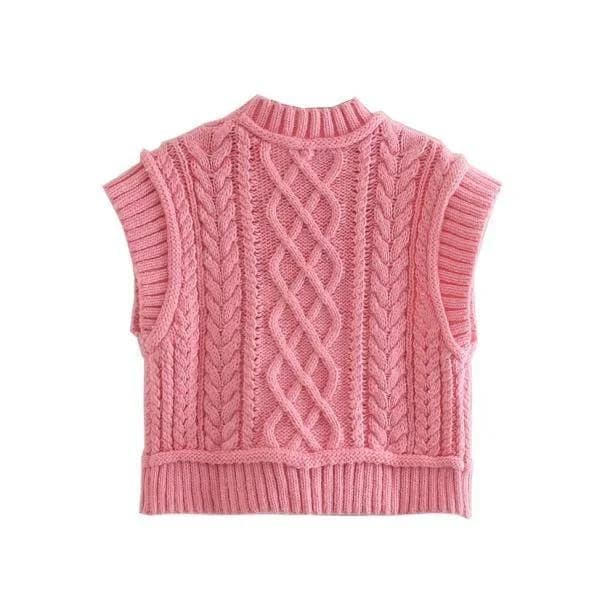
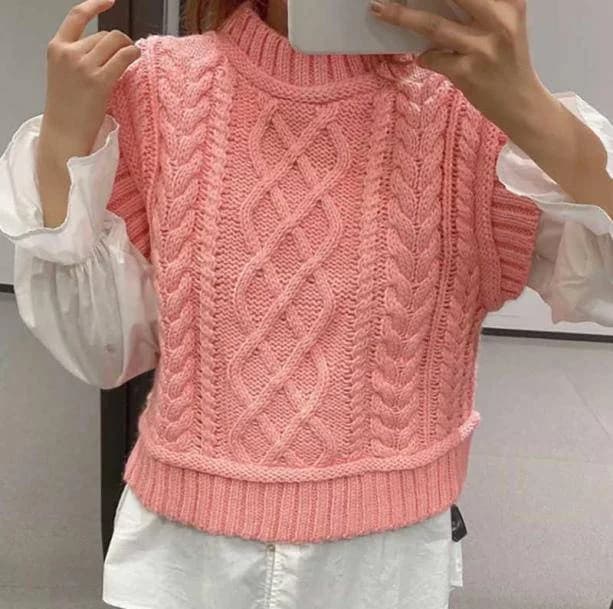
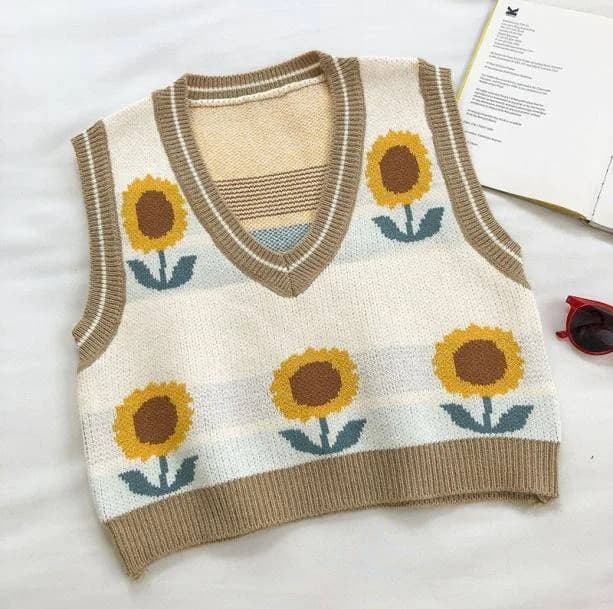
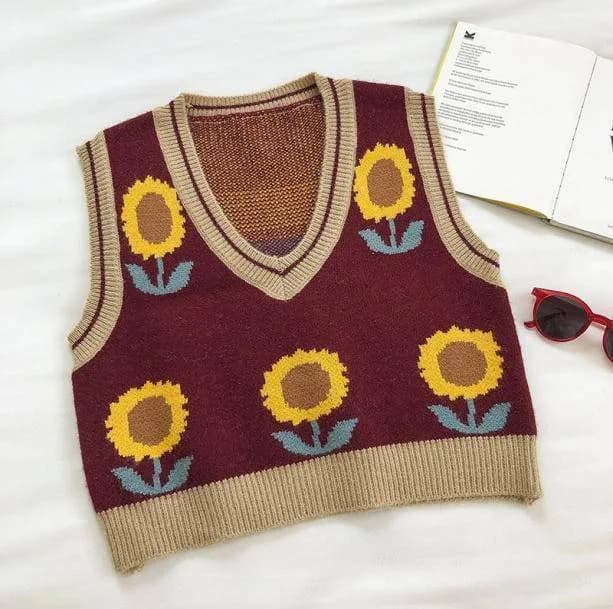
If sleeves are what add the bulk, a sleeveless knit solves a lot. Layered over a fitted long-sleeve top, it gives texture without the arm width. Two options in the shop work well in this role: the Pink Sleeveless Sweater, offered in S, M and L, and the Vintage Flower Sleeveless Sweater, available in Black, Red and Apricot in one size.
Try a sleeveless knit over a slim white or black long-sleeve tee, with straight jeans or a slim skirt. The tee keeps the upper half neat, the knit adds pattern, and your arms and torso stay in proportion.
The same layer also helps in changeable weather. Wear it alone on a mild day, add the tee when it cools off, and put a coat over it when it gets properly cold. Check each product page for details, since materials aren't listed for these pieces.

Statement Knits and Quiet Bottoms
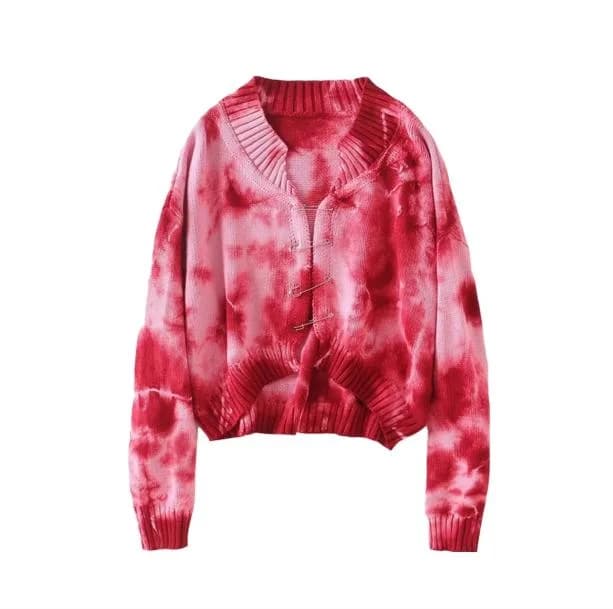
Busy sweaters need calm bottoms. If the knit has several colors, keep the skirt or jeans in one solid shade, ideally one that already appears in the sweater. The Color Explosion Sweater is listed in yellow, rose, blue, green or pink options in one size. With something this bright, dark straight jeans or a plain black skirt let the knit lead.
The Vintage Contrast Sweater and the Artistic Soul Sweater are both one size and listed as pictured. Look closely at the photos for the pattern scale, then pick a bottom that matches the quietest color in it.
If you like several patterns together, keep one clearly dominant. A patterned sweater with a plain slim skirt and patterned tights can work, but only if the tights are sheer or subtle. Otherwise, the eye has nowhere to rest and the outfit looks heavy.
- Pull one color from the sweater for the bottom
- Solid skirts or denim make the best backdrop
- Limit the outfit to one loud element


Softer, Neutral and Sized Options
Not everyone wants a loud knit. The Aesthetic Khaki Sweater is offered in S, M and L, and its neutral tone is easy to combine with dark jeans, a black slim skirt or cream tights. The Soft Kitty Sweater, also in S, M and L, suits a more playful outfit; pair it with a plain bottom so the design stays the focus.
The Sunset Sweater, in S, M and L, would suit a straight-leg jean in a dark wash that doesn't compete with its colors.
Since sizes differ across the range, choose based on how you want the fit. If a sweater is meant to be oversized, going down a size can change the whole silhouetteThe overall shape an outfit creates, from fitted to loose and layered.. Look at the product photos and size options to decide, and don't assume measurements that aren't listed.
Shoes and Socks: Finishing the Lower Line
Footwear affects how long and narrow the bottom half looks. Ankle boots with a slim skirt and tights create one continuous leg line. Chunky sneakers with straight jeans feel casual and balance a heavy top, because the shoe has some visual weight too.
Avoid very delicate shoes under a very thick knit unless the leg is bare or sheer. A tiny flat under a big sweater and wide jeans can make the outfit feel top-heavy.
With cropped jeans, the gap between hem and shoe matters. A little ankle shows the leg is narrower than the sweater. Slouchy socks over tights or leggings add cozy texture and fill that gap, but keep them in a color already in the outfit.
- Boots plus tights equals a continuous line
- Chunky sneakers balance heavy knits
- Show a sliver of ankle when you can
Weather and Layering Over a Heavy Knit
Coats are where boxy shows up most. A thick sweater under a straight, oversized coat can turn you into a rectangle. Choose a coat that's either shorter than the sweater or clearly longer and open, so the knit's hem and your bottom half remain visible.
Seasons vary by hemisphere, so go by temperature rather than month. In mild weather, a chunky sweater with a slim skirt and bare legs or sheer tights is plenty. In cold weather, use thermal-style layers that are thin, such as a fitted base layer, so you don't add width.
In rain or wind, a belted outer layer can restore a waist. If you don't have one, keep the coat open and let the sweater and bottom show as a column of narrower pieces.
- Open coats keep the vertical line
- Thin base layers instead of extra bulk
- Belt the outer layer if the knit is oversized
How to Compare Bottoms Before You Choose
When you're choosing between two bottoms for one sweater, run through a short comparison. First, width: which one is narrower than the sweater? Second, texture: which is smoother? Third, color: which gives contrast or picks up a shade from the knit? The one that wins in two out of three is usually the right pick.
Then check function. Can you sit, walk and lift your arms comfortably? A tight skirt with a heavy knit can feel restrictive if the sweater rides up. Straight jeans tend to forgive more.
If shopping online, compare product photos for rise and length rather than guessing. Start from the Sweaters page for the top, then look at skirts and jeans in the same colors. The sweaters collections give you more knit shapes to try with the same bottoms.
- Narrower than the sweater?
- Smoother than the sweater?
- Contrasting or echoing in color?
- Comfortable to move in?
Common Mistakes and a Final Checklist
The most frequent mistakes are easy to fix. Wearing baggy bottoms with a baggy knit is number one. Number two is a hem that ends right at the widest point. Third is a full tuck that creates a ring of fabric at the waist. Fourth is mixing too many heavy textures, like a thick knit with a bulky corduroy skirt.
Another one is ignoring the back view. Check it before you leave, because a tuck that looks good at the front can leave a bump behind. A quick glance in a second mirror or a phone photo will tell you.
Use this list before heading out: bottom narrower than the knit, hem not at the widest point, one small tuck or fold, a visible waist or high-rise line, one dominant pattern, and shoes that suit the weight of the outfit. If you can tick most of those, the outfit is shaped and you can relax.
- Bottom narrower than sweater
- Hem placed deliberately
- Small tuck, fold or belt
- One loud piece only
- Back view checked
- Shoes match the outfit's weight