Created by the Kawaii Vibe editorial team. Our named style desks are editorial personas. Product details and availability can change.
Balancing an outer layer comes down to managing weight, visual bulk, and hemline drop against the garments underneath. When you build an alternative outfit, jackets often set the boundary line for the entire look. If your jacket is cut wide and hangs straight past your hips, pairing it with wide pants shifts the whole visual weight downward. Conversely, throwing a cropped fitted layer over a long tunic-length graphic tee instantly breaks up torso lines in a very deliberate, early-aughts fashion.
Getting the proportions right does not require sticking to one rigid formula. Instead, it is about understanding how contrasting cuts interact. Whether you want a sharp contrast between skin-tight bottoms and an oversized hood, or a trim silhouetteThe overall shape an outfit creates, from fitted to loose and layered. built with snug knits and cropped hems, checking where each layer starts and stops keeps your outfit intentional rather than cluttered.
In this guide, we break down practical ways to arrange your layers using distinct silhouetteThe overall shape an outfit creates, from fitted to loose and layered.s, hem placements, fabric weights, and color contrast. We will also examine how specific staples, from zip-ups to structured denim, align across our wider Emo Clothes selection to help you fine-tune everyday styling.
The Core Principle: Establishing a Primary Silhouette
Before choosing which jacket to pull off the rack, decide where the focal volume of your outfit will live. Outfits generally fall into three structural shapes: top-heavy, bottom-heavy, or columnar. A top-heavy silhouetteThe overall shape an outfit creates, from fitted to loose and layered. pairs a relaxed, roomy outer layer with fitted legwear, which keeps the body line sharp while giving you full upper-body coverage. A bottom-heavy silhouetteThe overall shape an outfit creates, from fitted to loose and layered. does the opposite, anchoring wide trousers or layered skirts beneath a trimmed, close-fitting top layer. Columnar dressing keeps the volume relatively uniform from shoulder to ankle.
When browsing through dedicated Emo Jackets, looking at the shoulder seam placement and total length gives you an immediate read on silhouetteThe overall shape an outfit creates, from fitted to loose and layered. behavior. Dropped shoulders and long square cuts naturally add upper torso bulk. High shoulder seams and tapered waistbands pull the volume inward, allowing your lower garments to take center stage.
Deciding this primary shape upfront prevents the common frustration of feeling swamped by clothing. If your jacket carries dramatic hardware, thick lining, or oversized novelty details, letting it anchor the top half of your profile while keeping the bottom streamlined is almost always the easiest path to clean visual balance.
If a roomy jacket supplies the outfit’s upper-body volume, try a checked skirt below it rather than adding another bulky layer. Dark accessories can help keep the contrast focused on the jacket and skirt. The E-Girl Clothes collection offers a related reference for combining checks with dark details; the proportion choice can work with an emo outfit without making the styles interchangeable.
- Top-heavy profiles work best when your jacket extends below the hip over trim bottoms.
- Bottom-heavy profiles need short or fitted jackets that end at or above the hip bone.
- Columnar profiles rely on straight-cut jackets worn unzipped to show vertical inner lines.
Hemline Math: Cropped, Waist, and Hip Lengths
The exact point where your jacket hem rests against your torso changes your visual height and torso proportions. A cropped jacket ending right at the natural waist pulls the eye upward and lengthens the appearance of your legs. This hem works seamlessly with mid-to-high rise bottoms or layered over longer under-shirts where the bottom fabric peeks out below the jacket edge.
Waist-length hems hit around the beltline and act as a neutral divider. They provide enough coverage to keep warmth locked in without competing with back pockets, chain loops, or belt buckles. When styling a waist-length piece, keeping inner tops tucked or flush with the waistband keeps lines crisp, whereas letting a scoop tee drop three inches past it creates an asymmetric, layered rocker vibe.
Longer jackets hitting at the mid-thigh or knee introduce vertical drape. When wearing these, keeping the jacket unfastened exposes your central vertical axis, showing where your pants or skirt meet your top. Fastening a long jacket creates a solid block of color and shape, meaning your footwear and lower legwear will need to provide all the visual interest for the bottom half of the look.
Balancing Fitted Zip-Up Hoodies With Loose Bottoms
Fitted zip-ups represent an iconic foundational piece in alternative fashion. Because these jackets sit snugly against the ribs and waist, they naturally pair with relaxed or wide-leg trousers without looking sloppy. The clean upper line creates an anchor that grounds the movement of wider pants.
For instance, pairing the polyester Chain Skeleton Fitted Zip Up Hoodie in Black with relaxed pants creates an immediate counterweight. Because the hoodie features a closer cut across the chest and torso, it creates room to wear roomy trousers beneath it without swamping your frame. The chain and bone graphics across the chest provide high-contrast detail, drawing the eye upward.
To complete this specific balance, consider matching that snug zip-up with the Teen Craft Loose Fit Striped Pants. These cotton-polyester trousers feature bold vertical black-and-white stripes and a wide cut through the legs. The snug waist of the hoodie keeps the waistband of the striped pants clearly defined, letting the wide leg shape flare outward naturally for a classic skate-punk silhouetteThe overall shape an outfit creates, from fitted to loose and layered..
- Keep the hoodie zipped to mid-chest to form a clean V-neckline that frames inner necklaces.
- Allow the ribbed waistband of the hoodie to rest directly on your natural hip line.
- Avoid bunching thick shirts beneath fitted sleeves to maintain smooth arm lines.


Styling Oversized and Graphic Outerwear Over Slim Cuts
When an outer layer has substantial volume, such as a thick winter jacket or an oversized hoodie, keeping inner layers flat against the skin prevents unwanted bunching under the arms and across the shoulders. A bulky jacket needs breathing room inside so the fabric hangs as the designer intended, rather than catching on textured layers underneath.
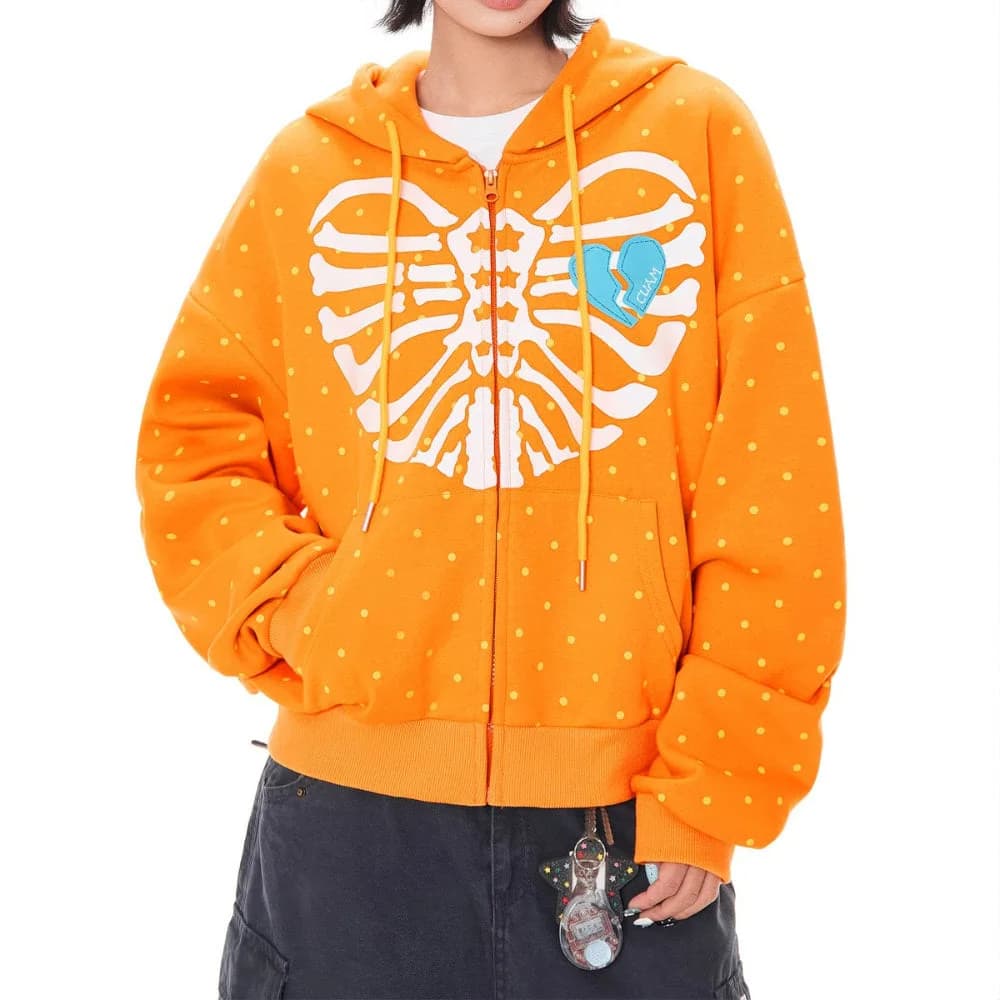
An oversized piece like the polyester Broken Heart Skeleton Zip Up Hoodie, available in Orange, Dark Grey, or Green, offers a relaxed upper block with graphic impact. Because it runs loose through the arms and body, throwing it over skinny denim or slim black trousers balances the proportions. Choosing one of the saturated color options like Orange or Green also makes the jacket the primary statement piece against dark lower separates.
Underneath this type of roomy layer, reach into our range of Emo Tops for flat, form-fitting options. Thin cotton or polyester base shirts let the oversized outer jacket slide on effortlessly. If you want to unzip the jacket while walking, the slim graphic top underneath remains visible without adding any bulk to the waistline.
- Choose thin, smooth base layers to reduce friction and fabric bunching inside the sleeves.
- Pair vibrant outer graphics with neutral, monochrome bottoms to maintain clear focus.
- Wear slim boots or fitted canvas sneakers to complete the tapered lower half.
Layering Textures: Faux Fur, Denim, and Knits
Proportion is not solely about geometric measurements; tactile depth changes how heavy an item appears to the eye. A faux-fur jacket or fleece-lined piece has visual weight that smooth cotton simply does not have. When combining heavy textures, mixing opposing surface finishes prevents your outfit from turning into a uniform wall of fuzz or denim.
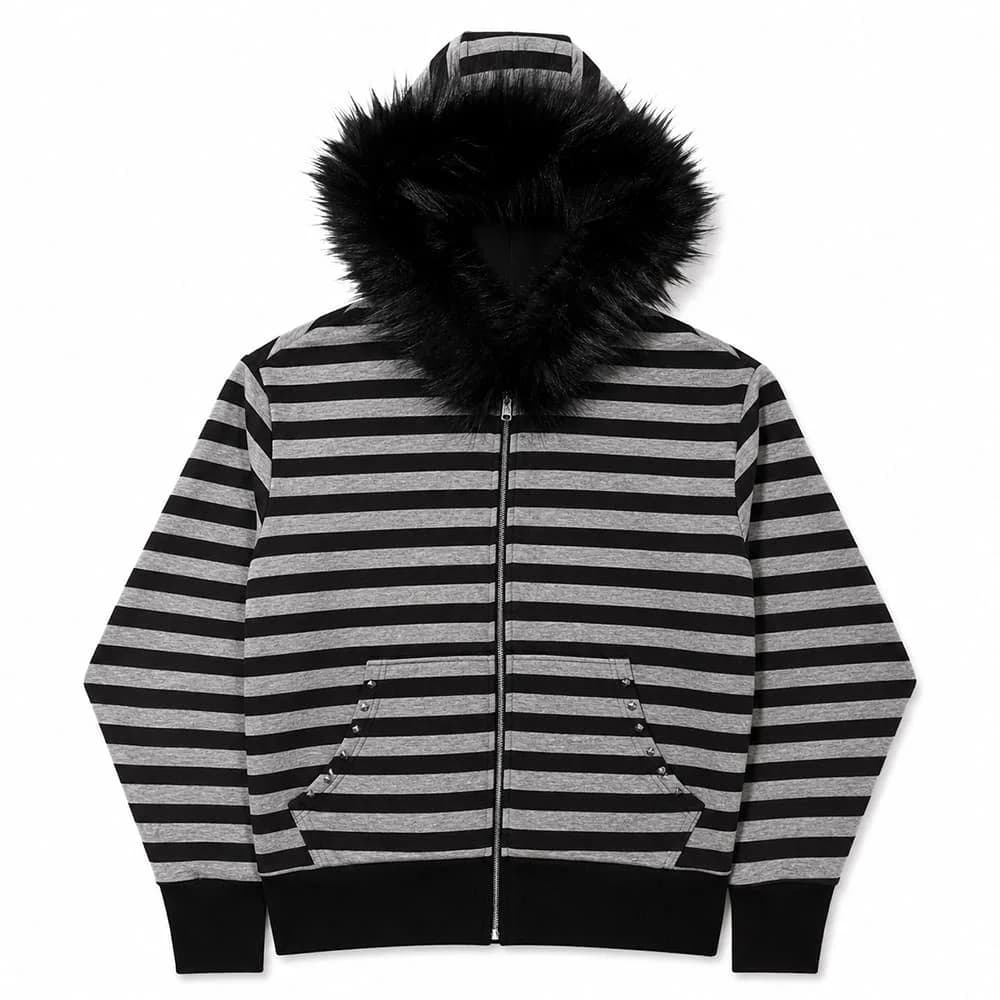
A textured outer piece like the 2000s Striped Faux Fur Zip-Up Hoodie in Black/grey introduces both pattern and plush pile. Because faux fur creates visual volume around the neck, shoulders, and chest, pairing it with smooth hardware-heavy trousers, coated denim, or flat twill bottoms offsets that softness. The horizontal stripe pattern also adds width, making it a natural match for sleek, vertical bottom layers.
When incorporating knits underneath heavy jackets, stick to fine-gauge knits rather than chunky cable knits. A fine ribbed long sleeve sits comfortably beneath faux fur or stiff denim jackets without binding your elbows or bunching around your armpits. If your jacket collar features fur or shearling, keep your inner shirt collar simple with a crew or scoop neck to avoid cluttering your throat.

Playing With Lengths: Outerwear Over Booty Shorts and Minis
Combining full-coverage outerwear with cropped bottoms is an established subcultural styling choice that balances warmth with exposed leg lines. When pairing long jackets with mini skirts or shorts, the key is managing where the jacket hem falls relative to the bottom hem of your shorts.
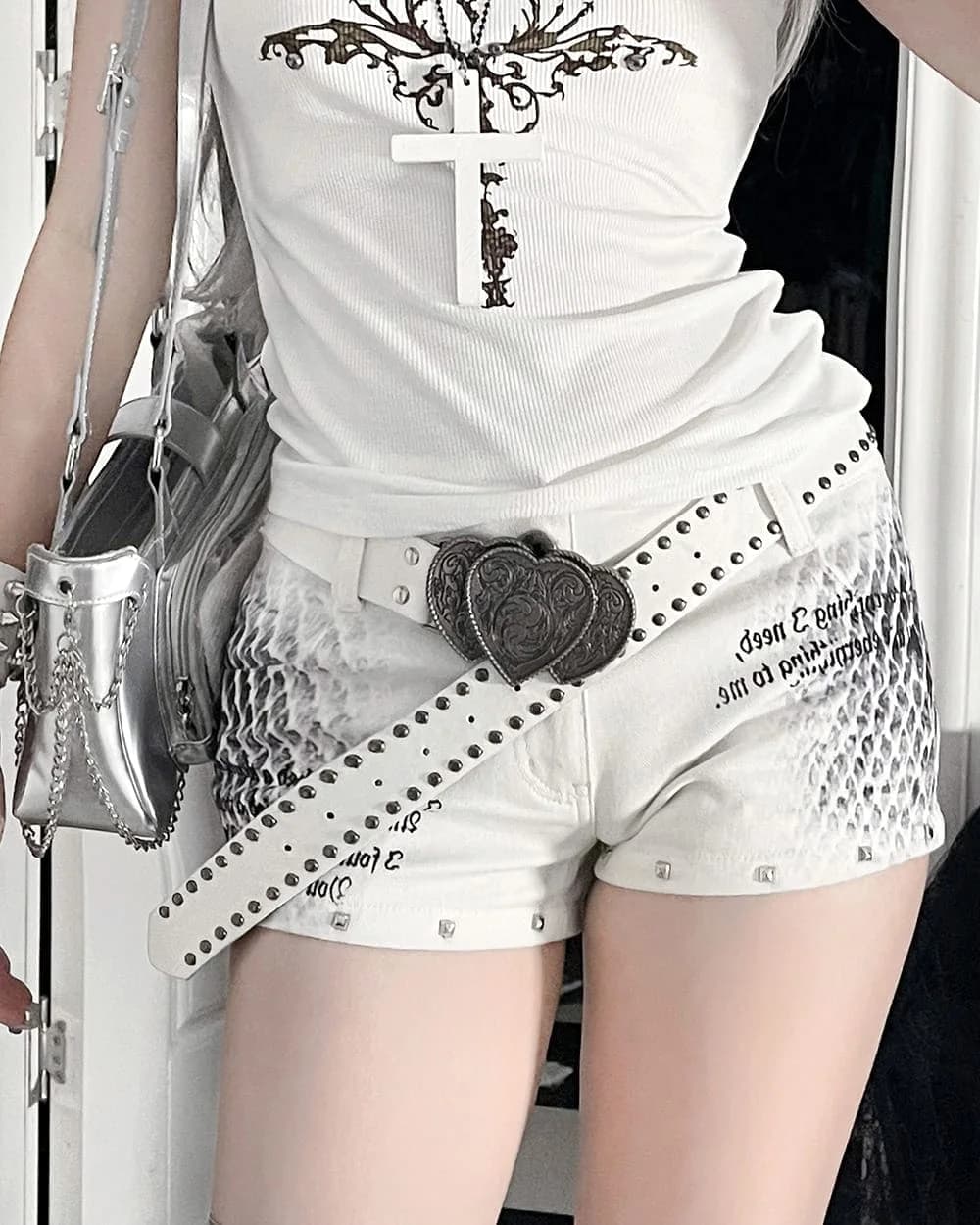
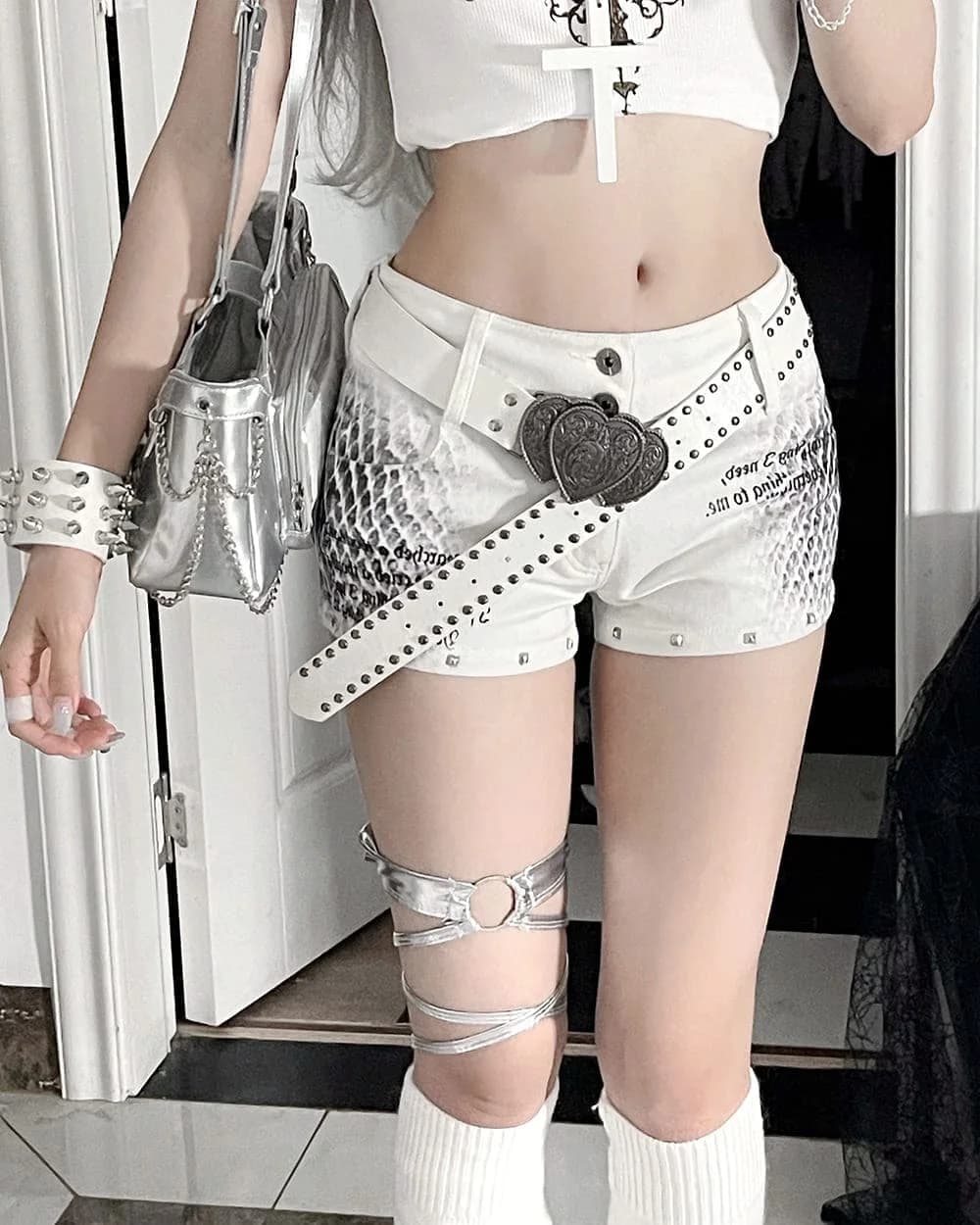
A high-contrast option is styling the 2010s Style Striped Booty Shorts, made of a cotton-polyester blend in Black/grey, beneath an open mid-length jacket. You can browse more short silhouetteThe overall shape an outfit creates, from fitted to loose and layered.s within our Emo Shorts catalog to find rises that suit your torso. If the jacket extends slightly past the hem of the shorts, leaving it unbuttoned or unzipped is critical; keeping it open ensures the shorts remain visible from the front, maintaining proper vertical outfit separation.
To make this look work across varying temperatures, ground the lower half with tall socks, fishnets, or chunky knee-high boots. This breaks up the exposed leg area into calculated sections. The vertical stripes on the shorts guide the eye downward, while a boxy jacket worn open frames the waistline and keeps the silhouetteThe overall shape an outfit creates, from fitted to loose and layered. balanced.
- Leave the outer layer unfastened if its hem falls below the hemline of your shorts.
- Add opaque tights or patterned fishnets to connect short hems to heavy boots.
- Tuck your inner graphic shirt into the shorts to clearly define where your waist sits.
Novelty Details and Silhouette Balance
Novelty features on outerwear—such as animal ears on hoods, detachable bondage straps, industrial safety pins, or chunky metal zippers—change where the eye travels. These elements add both physical weight and visual focal points, which need intentional pairing with the rest of your clothing.
A garment like the polyester Fawn Ear Grunge Hooded Jacket, offered in Black and Grey, places sculptural novelty ears directly on the hood. When the hood is up, it broadens the upper head silhouetteThe overall shape an outfit creates, from fitted to loose and layered.; when it rests down on the back, it adds soft dimension across the shoulder blades. To keep this upper detail from looking top-heavy or cluttered, pair it with simple, clean-lined bottoms and minimal neck accessories.
When wearing pieces with prominent hardware or novelty hood additions, avoid wearing large, chunky infinity scarves or high-volume choker stacks. Let the jacket collar and hood have space to sit naturally against your collarbone and neck. Streamlined legwear balances out playful upper volume and keeps your overall outfit anchored in alternative grunge territory.
- Keep chest and neck jewelry light when your jacket hood includes 3D elements like ears.
- Balance wide novelty hoods by wearing boots with noticeable tread or platform soles.
- Select matte fabric finishes for your pants when your outer layer carries distinct novelty accents.
Base Layer Foundations: Graphic Tees and Camis
What you wear underneath your jacket determines how versatile your outfit will be throughout the day. When you step indoors or move between varying climates, your base layer needs to hold its own while harmonizing with the jacket's colorway and collar style.
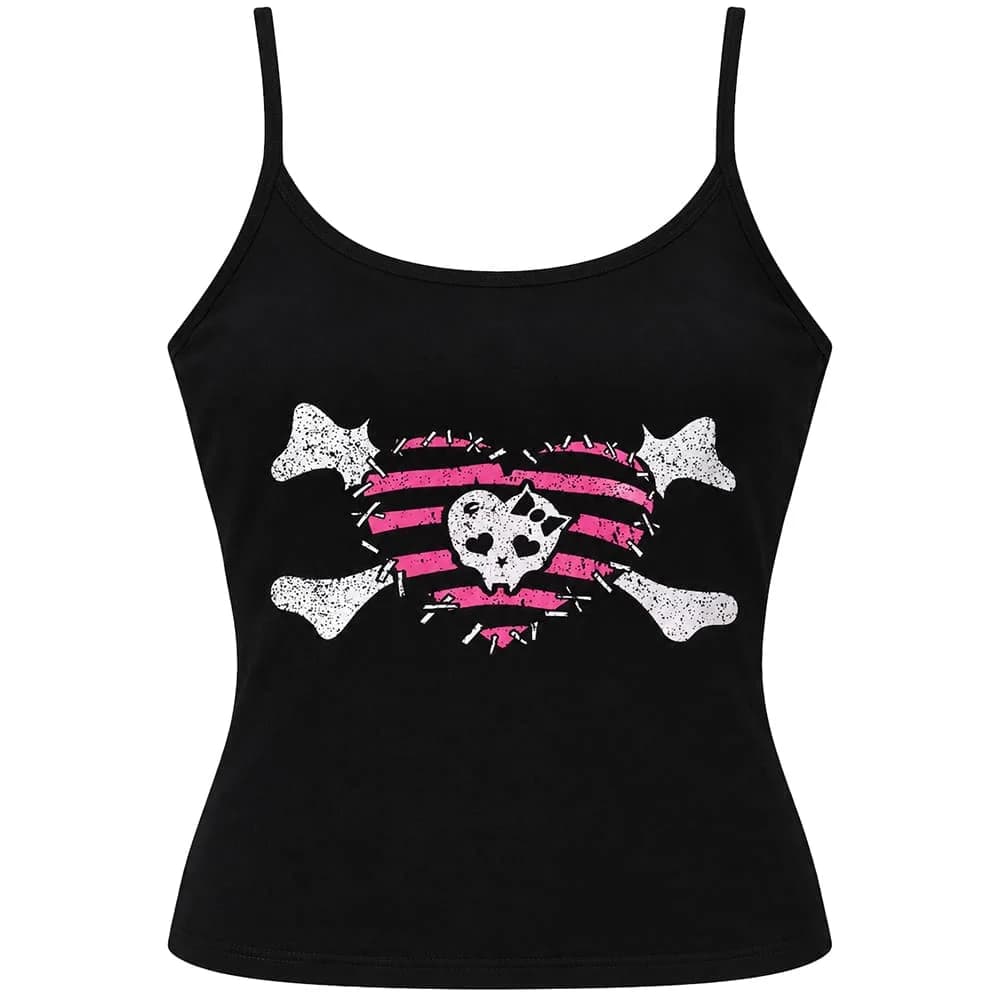
A fitted base like the polyester Emo Girl Skull & Bones Tank Top in Black provides a streamlined graphic center for unzipped styling. Because it is a sleeveless tank cut close to the body, it leaves arms free from friction, making it an ideal piece beneath fitted zip-ups or tight leather sleeves. The front skull-and-crossbones print sits high enough on the chest to remain completely visible even when an outer jacket is partially zipped up.
For cooler days, shifting to a long sleeve base like the polyester 2007 Era Leopard Skull Long Sleeve Top in White creates immediate graphic contrast. Its white fabric and bold skull graphic shine beneath a dark unzipped fleece or denim outer shell. The long sleeves also allow for sleeve-cuff layeringWearing pieces over or under one another to add depth, warmth or contrast., where you pull the printed cuff out past the jacket wrist for an extra touch of alternative styling.
- Pick scoop or crew tanks so the chest graphic remains readable through an open jacket front.
- Use contrasting base colors, such as white underneath black, to break up a dark silhouetteThe overall shape an outfit creates, from fitted to loose and layered..
- Ensure sleeve cuffs on under-layers fit flat against the wrist to prevent uncomfortable sleeve bunching.
Managing Mid-Layers: Hoodies Beneath Jackets
One of the most dependable layeringWearing pieces over or under one another to add depth, warmth or contrast. strategies in alternative fashion is wearing an unzipped or lightweight jacket over a pullover or zip hoodie. This dual-outerwear setup provides functional warmth while building substantial collar depth. However, managing the thickness of both pieces is critical to avoid restricting arm movement.
When styling across our collection of Emo Hoodies, select medium-weight knits if you plan to wear a structured denim or faux-leather jacket on top. The hood of the sweatshirt must pull cleanly over the jacket collar without bunching up behind your neck. If the jacket has its own collar, lay the hoodie fabric flat against your upper back before putting the outer jacket on, ensuring the hood drapes smoothly over the outer neckline.
Keep the base hoodie zipped halfway or three-quarters up, while leaving the outer jacket fully open. This configuration shows off the layered contrast of both materials without widening your waist profile. If both garments carry heavy graphics, aim for one busy print and one solid colorway to avoid visual clash.
- Pull the hood completely clear of the jacket collar to prevent bunching around your neck.
- Ensure the armholes of your outer jacket are cut wide enough to accommodate hoodie sleeves.
- Pair solid hoodies with graphic jackets, or graphic hoodies with solid outer shells.
Footwear as a Proportion Counterweight
You cannot fully solve jacket proportions without considering your footwear. Shoes serve as the visual baseline that supports the entire weight of your outer layers. If you wear an oversized, boxy winter jacket paired with paper-thin, low-profile canvas flats, the outfit can appear top-heavy and visually unsupported.
Thick-soled footwear—such as platform combat boots, creeper shoes, or skate sneakers with substantial padding—provides the visual weight required to anchor heavy outerwear. When wearing a long coat or an oversized zip-up, a boot with a 1.5- to 2-inch lug sole balances the bulk up top, creating symmetry between your shoulders and your feet.
If you are wearing cropped, fitted outerwear like a snug biker jacket or a tailored hoodie, you have more flexibility with footwear. Streamlined high-top sneakers or slim lace-up boots maintain the clean, sharp lines established by the fitted top half. Always look in a full-length mirror to check that the weight of your boots mirrors the volume of your chosen jacket.
- Pair oversized, padded, or faux-fur jackets with chunky lug-sole boots or platforms.
- Wear sleek sneakers or low-profile boots with cropped, fitted jackets to keep lines clean.
- Match the color tone of your footwear to your jacket details to tie the look together.
Climate and Seasonal Layer Adjustments
LayeringWearing pieces over or under one another to add depth, warmth or contrast. requirements change drastically depending on whether you are walking through damp winter air or heading to an indoor venue on a mild autumn night. Proportional balancing must adapt to these temperature shifts so you stay comfortable without sacrificing your alternative look.
In wet or cold climates, water-resistant outer layers or heavy polyester fleece become necessary. To keep from looking like a shapeless bundle, cinch your waist using a studded belt over your pants, and keep the jacket unzipped whenever you are indoors. Choose mid-layers with breathable knits so that unzipping your outer layer provides immediate ventilation.
For transitional or warmer weather, jackets transition into styling accessories rather than heavy survival gear. Lightweight polyester zip-ups or unlined windbreakers can be tied around the waist or hips when temperatures climb. Tying a jacket around your waist not only handles excess heat, but it also adds casual volume to the hips, which works exceptionally well over slim skinny jeans or simple mini skirts.
- Cinch interior beltlines to maintain torso shape when wearing unzipped heavy winter coats.
- Tie lightweight zip-ups around the hips to add volume to slim trousers in mild weather.
- Choose moisture-wicking base tops beneath polyester outerwear to stay comfortable indoors.

Common Proportion Pitfalls and How to Fix Them
Even well-curated alternative outfits can feel slightly off if small proportion errors creep in. One frequent issue is the 'floating hem,' where a jacket hits at the widest point of the hips while wearing tight, low-rise pants, creating an awkward horizontal line across the center of the body. To fix this, either switch to a shorter cropped jacket that hits at the waist, or extend down to a mid-thigh duster coat.
Another common pitfall is sleeve crowding. Wearing a thick knit sweater inside a slim-fitting jacket pulls the shoulder seams forward, restricting movement and creating odd creasing along the upper arms. Always check arm mobility when layeringWearing pieces over or under one another to add depth, warmth or contrast.: you should be able to raise your hands to your head comfortably without the jacket hem rising past your ribs.
Lastly, avoid the trap of matching loose with loose without a focal anchor. Pairing an oversized graphic hoodie with ultra-baggy pants can look effortless, but without an open front, a visible belt, or a structured shoe, it can turn into a shapeless silhouetteThe overall shape an outfit creates, from fitted to loose and layered.. Simply unzipping the hoodie to show a fitted base top instantly re-establishes your proportions.
- Avoid jackets that cut horizontally across the widest point of low-rise waistbands.
- Check armhole clearance to ensure your sleeves do not bind or bunch over mid-layers.
- Break up all-loose outfits by leaving outer layers unzipped over fitted base pieces.
How to Compare Outerwear Options for Your Wardrobe
When shopping for your next alternative jacket, look beyond just the graphic print or colorway and evaluate the structural specifications. The fabric composition, lining type, cuff construction, and hem finish dictate how the garment sits against other clothes in your closet.
Start by checking the material. Pure polyester builds, like those found in many graphic zip-ups, offer smooth draping, wrinkle resistance, and vibrant print clarity. However, they lack the stiff drape of cotton-twill or denim, meaning they will follow your body's shape more closely. If you want crisp, boxy lines that hold their own form, look for cotton blends or heavyweight twills that stand away from the frame.
Next, examine the hem and cuffs. Ribbed elastic cuffs and waistbands pull fabric inward, creating a blouson effect that emphasizes waistlines. Straight, raw, or split hems let fabric drop straight down, which is ideal for wearing over thick belts and wallet chains without catching. Comparing these small details ensures you buy a piece that works with the bottoms and base layers you already own.
- Check whether cuffs are ribbed or open to understand how sleeves will sit over wristwear.
- Choose rigid cotton blends for structured boxes, and polyester knits for relaxed drape.
- Look at hem construction to ensure it accommodates your belts, chains, and hardware.
Outfit Balancing Checklist
Before heading out the door, running through a quick physical checklist helps ensure your outerwear works harmoniously with the rest of your outfit. Visual balance is all about intentional contrast, and taking thirty seconds to review your silhouetteThe overall shape an outfit creates, from fitted to loose and layered. ensures every layer works together.
Start at your neckline and work downward. Are your collar details competing, or does your jacket frame your necklaces and inner collar cleanly? Move down to the torso: is there clear definition between your top layer and your bottoms, either through hem contrast or an open front? Finally, look at your feet to ensure your shoes provide enough visual weight to anchor the volume of your outer shell.
Keep these simple rules in mind as you put together everyday looks. Proportions are not about conforming to standard fashion conventions; they are about mastering clothing volume so your alternative style looks deliberate, expressive, and comfortable throughout your day.
- Check that your shoe volume matches the visual weight of your chosen jacket.
- Ensure your hood or collar rests flat without bunching uncomfortably behind your neck.
- Confirm that your belt, waistband, or inner shirt hem provides a clear horizontal dividing line.
- Test your arm movement to verify that inner sleeves do not restrict shoulder mobility.