Created by the Kawaii Vibe editorial team. Our named style desks are editorial personas. Product details and availability can change.
The quickest answer: wrap a thin strip of paper or non-stretch string around the base of your ring finger, mark where it overlaps, measure that length in millimetres, and compare it to a ring size chart. Do it more than once, on more than one day, and you will usually land on the right number.
Most double orders happen for boring reasons. Someone measured a cold finger, or used stretchy thread, or forgot that a chunky band sits differently from a thin one. None of that is hard to fix once you know it.
This guide walks through both home methods, explains why your fingers change, and covers wide bands and stacks. It also shows how to read product pages, because some rings here are adjustable or one size and some are listed in a single size. If you want to browse while you read, the main Rings collection is a good starting point.
Start With the Fast Answer and What You Need
You need very little: a strip of paper or a piece of string that does not stretch, a pen, a ruler with millimetres, and about ten minutes. Dental floss works if it is not the stretchy kind. Ribbon is fine if it is flat and firm. Avoid knitting yarn, elastic cord and anything fuzzy, because they compress or stretch and give you a number that is off.
The goal is the circumference of your finger at the spot where the ring will sit, which is usually the base. Once you have that length in millimetres, you match it to a size chart. Charts differ between the US and Canada, the UK and Australia, and parts of Europe, so always check which system you are reading before you trust a number.
Before you start, decide which finger the ring is for. Your index, middle and ring fingers are rarely the same size, and your dominant hand is often a little larger. Measure the exact finger you plan to wear it on, not the one you assume is similar.
Keep a note on your phone as you go. Write the finger, the hand, the time of day and the measurement. It sounds fussy, but it turns a guess into a pattern you can trust.

The String or Paper Strip Method, Step by Step
Cut a strip about 15 cm long and no wider than a centimetre. Wrap it once around the base of the finger, snug but not tight, like a comfortable bracelet. Use the pen to mark the exact spot where the end meets the rest of the strip, then unwrap it and lay it flat against the ruler.
Measure from the end of the strip to your mark. That is your circumference. If you would rather work from diameter, divide by 3.14. Then check both numbers against the chart you are using. Most retailers publish one, and it is worth using the chart for the specific store rather than a random one you found.
Repeat the wrap three times and compare. If the results differ by a millimetre or so, take the middle one. If they differ more, you are pulling too hard some of the time, so slow down and aim for the same pressure each go.
The real test is the knuckle. A ring has to slide over it, then sit at the base without spinning around. If your knuckle is much bigger than the base, you need a size that clears the knuckle and may want to add a little grip with a thinner, snugger style.
- Use non-stretch string, floss or a paper strip
- Mark the overlap with a pen, then measure flat
- Do three wraps and use the middle result
- Check the knuckle as well as the base
The Printable Ring Sizer Method
Printable sizers are paper rings or a set of circles you hold a ring against. They are handy if you already own a ring that fits well, because you can place it over the circles and find the match. Some also come as a cut-out strip you wrap and slide through a slot, which works like the string method with built-in markings.
The big catch is print scale. If your printer shrinks the page to fit, every circle becomes wrong. Choose actual size or 100 percent in the print settings, never fit to page. Then check by holding a ruler or a bank card against the printed scale line, if the sizer has one. If the line is not the length it claims, reprint.
Use the circle method for ring-on-paper comparisons and the strip for bare-finger readings. If the two disagree, trust the one you did more carefully, and measure a third time. A ring you own and love is a very useful reference, especially if it is similar in width to what you plan to buy.
Do not size using the outside of a ring. You want the inside diameter, edge to edge across the hole. Placing a ring on top of the circles and lining up the inner edge is the usual way.
Why Your Finger Size Changes During the Day
Fingers are not fixed. They are often a bit smaller first thing in the morning and larger later in the day, after a hot shower, a long walk or a salty meal. Cold hands shrink and warm hands swell. That is why a measurement taken in an air-conditioned room can feel wrong at the beach.
The practical fix is to measure at a neutral time, such as mid-afternoon at normal room temperature, and to repeat it on a second day. If the readings are close, you are done. If they swing, pick a size that fits your usual state and accept a slightly snug feeling on cooler days.
Climate matters in all five of our main countries, and it does not follow one calendar. A humid week, a heatwave or an overheated flat in winter can all shift how a ring sits. Think about the conditions you will actually wear the ring in rather than the day you happen to measure.
If you are between two sizes, consider the style. A thin band that sits close may be happier a touch snug, while a wider band often feels better with a little breathing room.
- Measure mid-afternoon, hands at room temperature
- Take readings on two different days
- Skip measuring right after exercise or a cold outdoor walk
- Decide by how you will wear the ring most often
Different Fingers, Different Sizes
Many people are a different size on each finger. Your middle finger might be half a size up from your ring finger, and your thumb can be two or more sizes bigger than your pinky. Your two hands can also differ, so measure the specific hand you intend to wear it on.
If you plan to wear rings across several fingers, make a small table. List each finger on each hand, with the circumference and the chart size beside it. This takes a few minutes and saves you from the classic mistake of buying a whole set using only your ring finger size.
For fun styles like midi rings or a ring on the index finger, measure at the spot where it will actually sit. A midi ring goes above the knuckle, where your finger is narrower, so a base measurement will run too large. Wrap the strip around that upper segment instead.
For thumbs, add a thought for movement. Thumbs bend a lot, and a very tight thumb ring can feel annoying when you grip things. Leave a little more room there than you would on a ring finger.
Wide Bands Need More Room
A wide band covers more skin, so it feels tighter than a thin band of the same size. If you normally wear a narrow ring and want a chunky one, you may need to go up a little. A common approach is to wrap a wider strip of paper, about the width of the band, because that copies how the ring will sit and grip.
Check the knuckle too. A wide band that fits the base may struggle to pass a larger knuckle, and then it sits loose once it is on. If this describes your hands, a style with a bit of flex or adjustability is easier than chasing an exact fixed size.
Oversized and statement designs often add bulk in other ways, like a big heart or a twisted form. The Blush Oversized Heart Ring is listed in White and Pink in size 7, so it suits you only if a 7 matches your measurement for that finger. If you are not sure, measure first and treat the listed size as fixed, not approximate.
When comparing, look at the listed size, the colour options and how the product is described. Do not assume that a size will stretch. If the page lists a single size, that is the size you are getting.

Adjustable and One Size Rings, Explained
Some rings are listed as adjustable or one size, which can ease sizing worries, though not remove them. Adjustable usually means the shape can be opened or closed a bit. It does not mean the ring suits every finger, so you still want a rough idea of your measurement and a sense of how much give a style has.
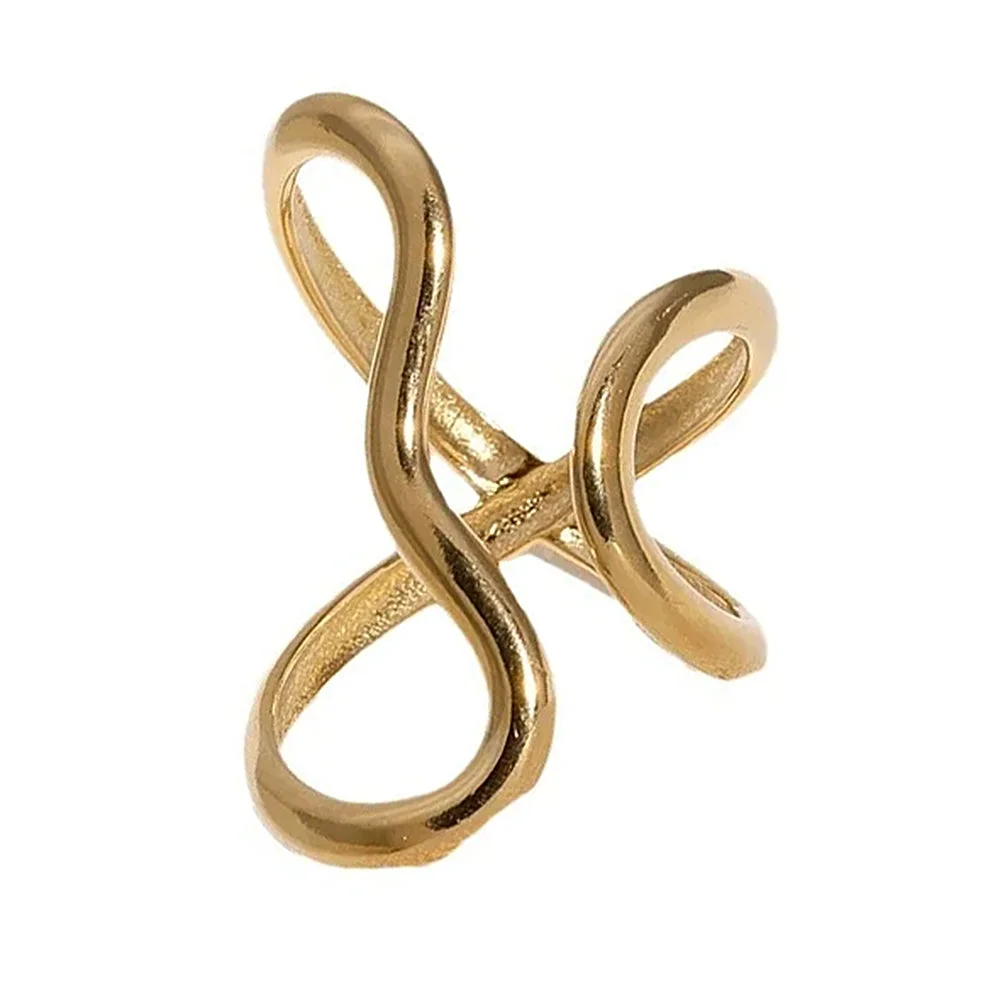
The Infinity Twist Oversized Ring is listed as Adjustable in Gold and Silver. That makes it an easier pick for a finger that varies through the day, or for a gift where you are not certain of the size. Check the product page for any extra detail before you order.
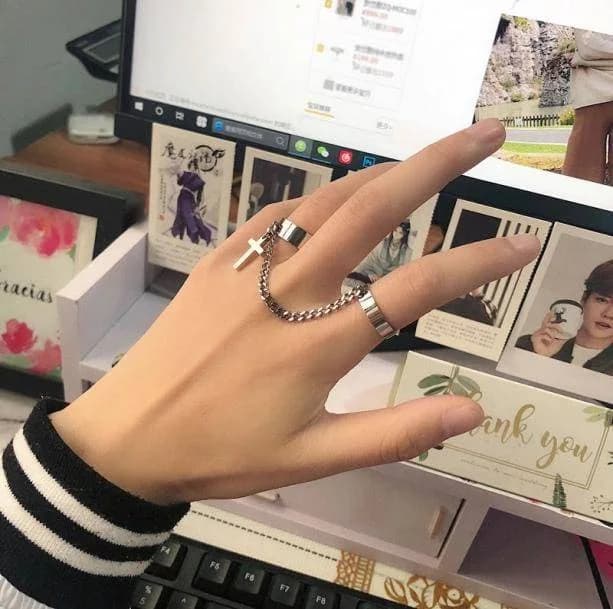
The Cross Chain Rings are described as alloy metal with a silver-tone finish and an adjustable, one size fit. The Four Fingers Chain Rings are listed as one size, as pictured. Because that is a linked style across several fingers, the way it sits will depend on your hand, so look at the photos and think about the spacing between your fingers.
Handle adjustable rings gently. Adjust once to a comfortable spot rather than bending back and forth repeatedly. We do not make claims about how long any ring will last, so treat them kindly and avoid forcing them.
Sizing for Stacks and Sets
Stacking changes everything. Two or three thin bands on one finger squeeze together, and the combined width acts like one wide band. If you want a stack, measure with a wider strip or add half a size to your single ring figure. Think about how many rings you want on that finger in total.
Sets spread the sizing problem across several fingers. The E-Girl Rings Set and the Grunge Rings Set are both listed as one size, as pictured. Before ordering, check the photos to see how many pieces come in the set and think about where you would wear each. Sets are a nice way to try a stacked look without picking each ring separately.
The Y2K Aesthetic Rings come in White, Blue, Green, Pink, Orange, Dark Green and Brown, one size. If you are planning to mix colours across fingers, you can pick shades that sit next to each other in a stack and keep the rest simple.
A good rule is to spread rings out. One bold ring on your index, one thinner ring on your ring finger and a small one on your pinky looks balanced and avoids the squeezed feeling of three on one finger.
- Add roughly half a size for stacked thin bands
- Measure with a wider strip for chunky pieces
- Spread rings across fingers to stay comfortable
- Check how many pieces a set includes in the photos

Outfit Pairings That Help You Choose a Size and Style
Think about what you will wear the ring with, because it can change which fit you want. With a plain white tee and jeans, one oversized ring on the index finger is the star, so a snug and secure fit matters. Pair it with small studs and nothing else so the ring is the focus.
For a soft, pastel look, like a knit cardigan, a pleated skirt and ballet flats, a pink or white heart style sits well on the ring finger with a thin band on the pinky. If you like bold accessories, the Oversized Butterfly Earrings, available in Gold and Silver, can echo the shapes of your rings while keeping your hands uncluttered.
For a darker, layered outfit such as a black tee, cargo trousers and chunky boots, a grunge or e-girl style set fits the mood. Wear two rings per hand rather than all of them at once, and balance a heavy hand with a lighter one on the other side.
Weather and activity matter too. In hot or humid conditions your fingers may swell, so pick the slightly roomier size or an adjustable style. In cold weather, a ring can slip, so check that it will not fall off when your hands shrink.
Compare Options Before You Click Buy
Open two or three tabs and compare the same details across each product page: listed size, colour options, material notes and any adjustability. If a page leaves out a detail, such as material, do not assume it. You can contact the store with questions instead of guessing.
Browse by mood in the collections. The Aesthetic Rings page is useful for styles built around a look, while the Kawaii Jewelry collection leans cute and playful. If you want to pair rings with earrings and other pieces, the wider Jewelry collection keeps everything in one place.
Check your measurement against what you are comparing. Is the product adjustable, one size or a fixed size like 7? Those mean different things. A fixed size needs a good match, an adjustable ring needs a rough range and a one size ring needs you to look at the design and the photos.
Write down your top two choices and why. This stops the scroll spiral and helps you make a calm decision rather than ordering three just in case.
Common Sizing Mistakes to Avoid
The first mistake is using stretchy material. A thread that gives even a little will understate your size. The second is measuring a cold, tired or swollen hand and treating it as your normal figure. Both are easy to avoid once you know about them.
Another trap is mixing up systems. A US 7 is not the same as a UK or Australian letter size, and a chart in millimetres is easier to trust than a number you half remember. Always convert from your circumference using the chart linked to the store you are buying from.
People also forget the knuckle. A ring that slides on with effort and then leaves a red mark is probably too small for comfort, even if the base measurement says otherwise. If you have to twist and pull hard, size up or choose an adjustable style.
Finally, do not size from a ring that never fit properly. Check that your reference ring actually sits well on the same finger, otherwise you will copy the mistake into your next order.
- Stretchy string understates your size
- Cold or swollen hands give misleading readings
- Check the chart system before trusting a number
- Ignoring the knuckle leads to rings that stick or spin
Between Sizes: How to Decide
If your measurement falls between two sizes, use the style as a tiebreaker. For thin bands, the smaller size often feels secure and neat. For wide bands, stacks and anything chunky, the larger size is usually more comfortable. If you have a large knuckle, lean toward the bigger option.
Think about your lifestyle as well. If you type all day, wash your hands often or carry shopping bags, a ring that slides easily may feel better than one that is snug. If you move your hands a lot and worry about losing a ring, a snug fit is more reassuring.
Adjustable styles are the easiest answer to the in-between dilemma. A piece like the Infinity Twist Oversized Ring lets you tune the fit slightly, so it is a sensible option when you are right on the border and do not want to guess.
If you still cannot decide, ask yourself which mistake would annoy you most: a ring that is a bit loose or one that is a bit tight. Your answer usually points to the right size.
A Simple Checklist Before You Order
Run through this list right before you check out. It takes two minutes and catches most of the errors that lead to returns or second orders. Keep your finger notes nearby so you can match the figures to the product details.
Then take a breath and look at the full picture. Do the size, colour and style all match what you planned? Is the ring for a single finger or part of a stack? Does the design suit the outfits you actually wear most often?
If you are buying as a gift, be extra careful. Choose an adjustable or one size style rather than guessing a fixed number, and look at the product photos to judge whether it feels like the recipient's taste.
Once your order arrives, try it on at a calm moment, at room temperature, and check the fit at the knuckle and base. Keep your notes so next time you can buy with confidence.
- Measured the right finger on the right hand
- Repeated the measurement on two days
- Used a non-stretch strip and a millimetre ruler
- Checked the store's size chart and system
- Allowed extra room for wide bands or stacks
- Read whether the product is fixed, adjustable or one size
- Looked at colour options and product photos
- Saved my notes for future orders
What to Do If the Ring Still Does Not Fit
Even careful measuring can miss. If a ring arrives and feels wrong, first retry it at a different time of day. Fingers vary, and a ring that felt tight in the morning may be perfect in the afternoon. Give it a fair second try before you decide.
Next, check the store's return or exchange information on the relevant pages, since policies differ and we do not want you relying on assumptions. Keep the packaging and avoid wearing the ring in ways that could mark it while you decide.
Use what you learned to improve your notes. Was the ring too tight at the knuckle, too loose at the base, or just uncomfortable because of its width? Write that beside your measurement so your next order is better informed.
Then browse again with new knowledge. The Rings collection has plenty of styles, and with a clear measurement and an idea of how wide or stacked you want to go, you can pick the next one with a lot less guesswork.