
Created by the Kawaii Vibe editorial team. Our named style desks are editorial personas. Product details and availability can change.
Here is the short answer to how jeans should fit: the waistband sits flat against your body without digging in, you can slide a flat hand in at the back without a big gap, you can sit and squat without the rise pulling, and the hem lands where you planned it to. Everything else, like wash and leg shape, is taste.
Most fit problems come down to three numbers: waist, rise and inseam. Brands print them on size charts, and once you know how to read them against your own measurements, ordering gets much less of a gamble. This guide walks through each one, then gives you a home check you can do in about ten minutes.
We are a retailer, not a manufacturer, so we will stick to what is on the product pages and to general fit logic. Always check the size chart on the page you are buying from, because charts differ between styles.
The Quick Answer: What Good Fit Looks Like
Good fit is easier to spot than to describe, so use a few checkpoints. Standing, the waistband should lie flat and follow your body, not fold over or flare away at the back. Sitting, it should not cut into your stomach or slide down. Walking, the fabric should move with you without bunching hard at the knees or crotch.
Wrinkles tell you a lot. Soft horizontal creases at the hips are normal in any non-stretch denim. Sharp diagonal whiskers pulling from the crotch usually mean the rise or hip is too tight. Fabric pooling under the seat means too much room or a rise that is too long for you.
Keep in mind that fit is a range, not a single right answer. A loose, slouchy pair is meant to hang off the hip, while a skinny pair should hold close. Decide the effect you want first, then judge the pair against that, not against a generic ideal.
Rise Explained: Low, Mid and High
Rise is the distance from the crotch seam to the top of the waistband. It decides where the jeans sit on your torso, and it affects comfort more than most people expect. Charts often list it in centimetres or inches, usually for the front rise.
As a loose guide, a low rise sits on the hip bones, a mid rise sits a couple of finger widths below the navel, and a high rise sits at or near the navel or above. Those labels are not standardised, so trust the printed measurement over the word on the tag.
To find your own preferred rise, measure a pair you already love. Lay them flat, then measure from the crotch seam up the front to the top of the waistband. Write that number down. It becomes your benchmark when you compare charts. If a new pair is more than about 2 cm (roughly an inch) off your benchmark, expect it to sit noticeably differently.
- Measure your favourite pair flat, front rise only
- Compare that number to the chart, not the label
- Longer torsos often prefer higher rises; shorter torsos may find them reach the ribs
Inseam and Hem: Getting Length Right
Inseam runs from the crotch seam down the inside leg to the hem. Same trick as rise: measure a pair that ends where you like, flat, then use that number. Do this for each leg shape you wear, because a straight leg and a flare want different lengths.
Match length to the shoes you wear most. Straight and loose jeans can break softly on sneakers or stop at the ankle. Flares and wide legs look best long enough to skim the floor in your usual heels or platforms, with the hem almost hiding the shoe. Too short a flare looks like a mistake, while too long drags and frays.
If you are between lengths, go longer. You can hem or cuff, but you cannot add fabric back. A simple cuff of one or two turns also works on straight and loose pairs, and it changes the proportion in a way that suits chunky shoes.

Reading a Size Chart Step by Step
Start with a soft tape measure and measure your natural waist, which is the narrowest part of your torso, and your hips at the fullest point. Keep the tape level and snug but not squeezing. Do it over thin clothing or bare skin, not over thick layers.
Then look at what the chart actually lists. Some charts give body measurements the size is designed for, and others give the garment's flat measurements. Flat garment measurements need to be doubled for waist and hip to get the full circumference. Reading one as the other is the most common ordering mistake, so check the wording above the table.
Finally, look at the stretch. Stretchy fabrics can be sized closer to your measurement, while rigid cotton usually needs a little more room. Sizes on our listings run in letters such as S, M and L, and some styles go up to 2XL or 3XL, so the chart matters more than the letter. If you land between two sizes, think about whether you want a snug or relaxed result and pick accordingly.
- Measure waist and hips, level tape, no pulling
- Check if the chart is body or garment measurements
- Double flat garment figures for circumference
- Allow more room in non-stretch fabric
Waist Gap: Why It Happens
A waist gap is the space at the back of the waistband when the jeans fit your hips and thighs. It happens because many patterns are cut with a straighter line between waist and hip than most bodies have. If your hips and seat are fuller than your waist, you size up to fit them and the waist floats.
Rise matters here too. A high rise that reaches the narrowest part of your torso hugs better than a mid rise that sits where the body is wider. Gapping is often worse in rigid, unshaped denim and softer in fabrics with a little give.
A small gap, where you can fit a flat hand with the waistband still touching you at the sides, is normal and usually fine. A gap that lets the waistband fold forward when you sit is worth fixing. That is the point to try one of the adjustments in the next section.
Fixing a Waist Gap at Home
The most reliable fix is a tailor taking in the centre back seam, which removes the extra width exactly where it sits. It is a quick and usually inexpensive alteration, but ask for a quote first and make sure belt loops and back pockets stay balanced.
For no-sew fixes, a belt is the obvious one. Choose a thin to medium belt and cinch it just enough to pull the gap in, then wear a top that skims over it. Elastic waist adjusters or button tighteners can help, and tucking a fitted bodysuit or tee can keep the waist looking neat. Avoid heavy bulk at the back that shows through.
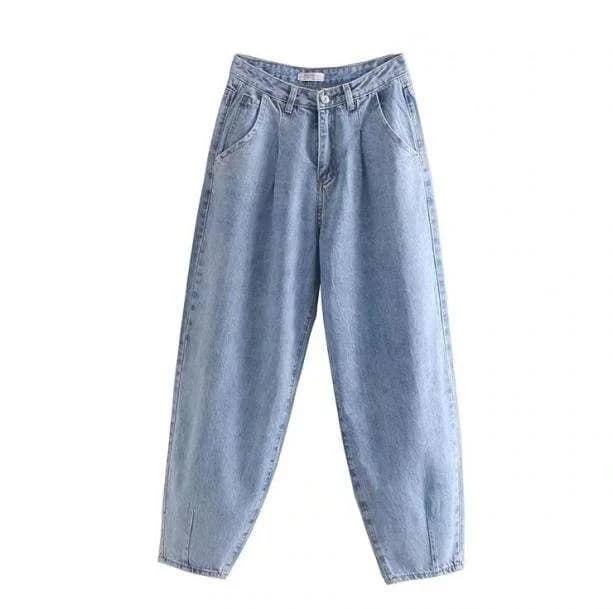
A third option is to buy for the waist and alter the hips, but this is harder. Letting out seams is limited by how much seam allowance exists. If your waist gap is big in every pair you try, look at styles cut with a curvier shape or stretch, or consider a loose silhouetteThe overall shape an outfit creates, from fitted to loose and layered. where the gap does not read as a fit flaw. The High Waist Loose Jeans are a cotton relaxed option in XS to L, worth a look if you want ease at the hips without chasing a tight waist.
The Home Fit Check, Step by Step
Do this when your jeans arrive, indoors, with the tags still on and the floor clean. Wear the shoes and a top you plan to style them with, so you judge the real outfit and not a half version.
Button and zip up, then stand straight and look in a mirror from the front, side and back. Check that the waistband lies flat and the pockets are not gaping. Then do the movement test: sit on a chair for a minute, squat down, lift a knee, and walk across the room. Notice any pinching, rolling or sliding.
Finish with the hand test and the hem test. A flat hand should slip into the back of the waistband with a little resistance, not a lot of empty space. Then check the hem in your usual shoes. If you are unsure, take a photo from behind, because it shows what a mirror hides. Keep the jeans in clean, unworn condition until you decide, and check the returns policy on the store page before you start.
- Wear your real shoes and top
- Check front, side and back in a mirror
- Sit, squat, walk for at least a minute each
- Hand test at the back of the waist
- Hem test in your usual shoes
- Photo from behind before deciding

Matching Rise to Your Torso and Outfit
Rise changes proportions. A high rise lengthens the leg line and pairs well with cropped tops, tucked tees and bodysuits. A mid rise is the easy default for longer tops and untucked shirts. A low rise suits shorter or cropped layers, but needs a belt or a snug fit to stay put.
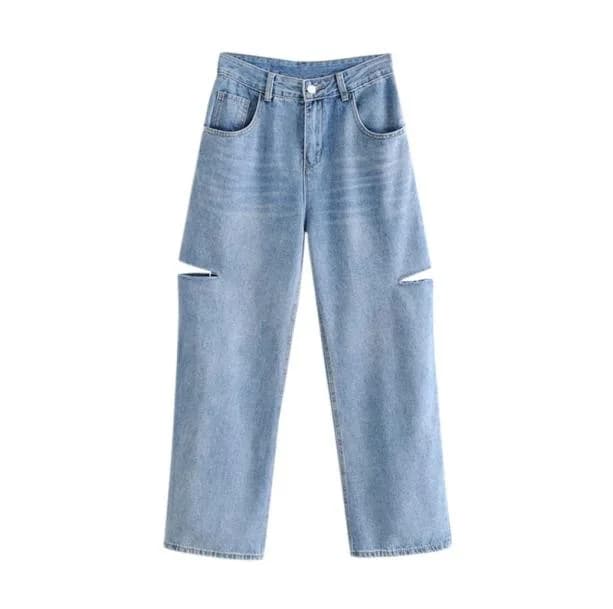
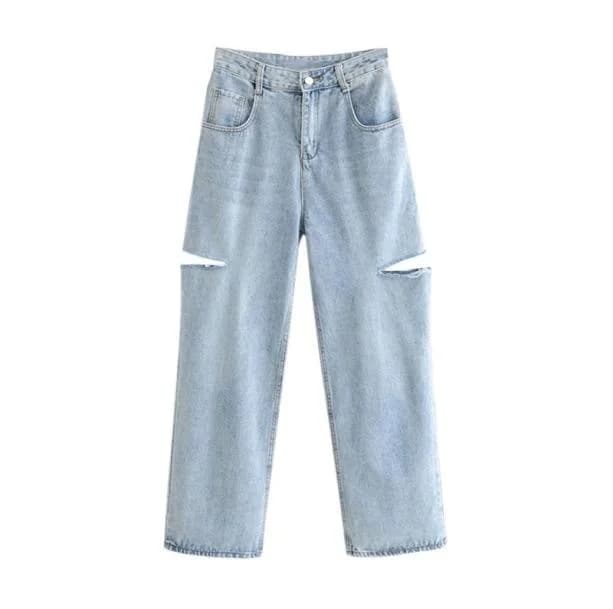
Try a worked example. For a high-rise outfit, pair the 90s High Waist Ripped Jeans, offered in Blue and Sky Blue in S to L, with a fitted tee tucked in at the front only and white trainers. The tuck defines the waist and lets the jeans do the work. For a looser line, swap in a boxy tee and a belt for shape.
If you have a short torso, a very high rise may feel like it reaches your ribs when you sit. Go a notch lower, or choose a style with a stretch waistband. If you have a long torso, a higher rise can feel more secure and cover more. Always compare the printed rise number to your benchmark pair.
Leg Shapes and What They Do to Fit
Leg shape decides how the thigh, knee and hem sit. Straight legs keep a consistent width and are forgiving. Loose and wide legs add volume and hide the thigh, but they depend on getting the waist and length right. Flares fit close through the thigh and open from the knee, which makes length especially important.
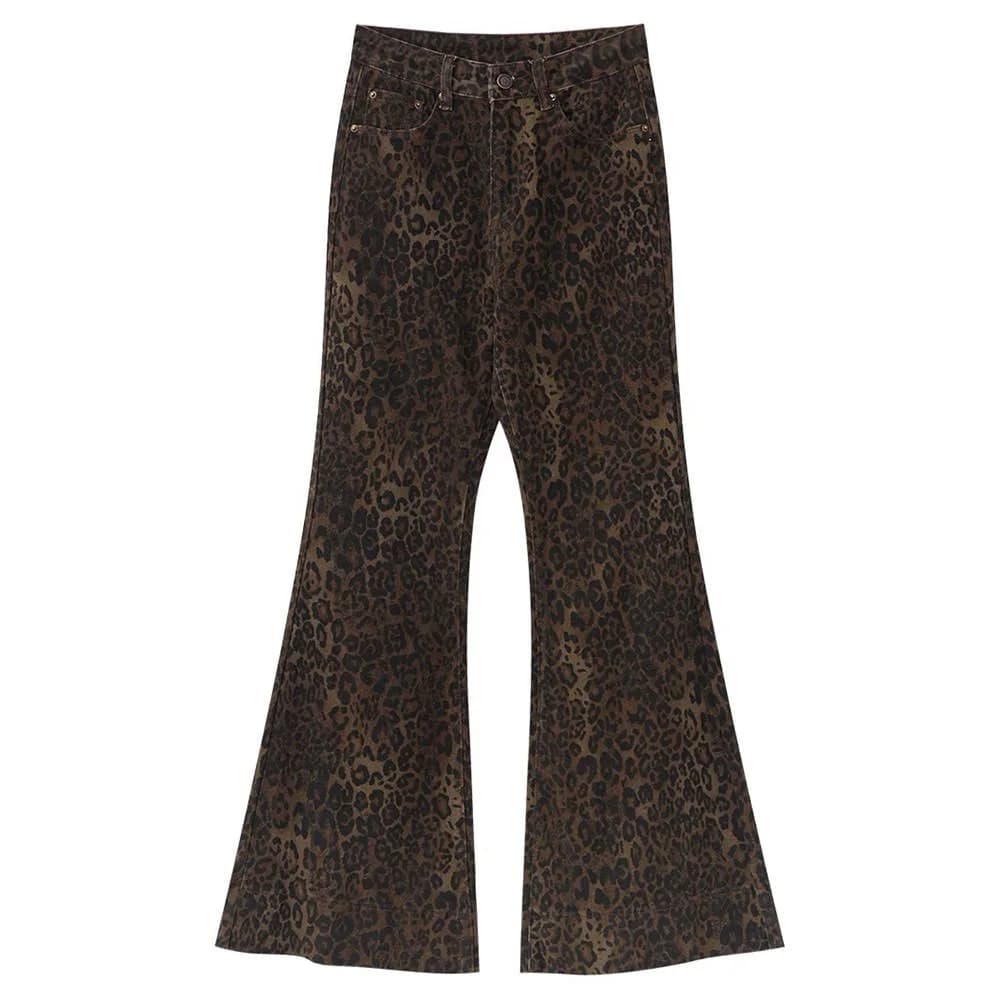
For a flare, try the High-Waisted Leopard Flare Jeans, a brown denim option in S to L, with a plain fitted top and platform boots. Keep the print as the focus by choosing simple colours elsewhere. For a bolder shape, the Y2K Bad Reputation Flare Jeans in black denim run from S to 3XL, which makes them one of the wider size ranges here. A black pair works with nearly any top, so it is an easy flare to start with.
When comparing, look at thigh and leg opening measurements if the chart lists them. Two jeans with the same waist can feel nothing alike if the thigh is cut differently. If the chart does not list them, keep the fit more flexible by choosing a looser cut.


Statement Details and How They Change Sizing
Details like cross panels, asymmetric fronts, peplum waists and ripped knees all affect how jeans sit. They add structure at the waist, which can help or hinder. A cross or wrap panel can add a little adjustability, while a peplum adds volume at the hip that you want to balance with a fitted top.
The Cross Waist Jeans come in S to 2XL and the Irregular Front High Waist Jeans in the same range. Both are styles where the waist is the feature; because neither listing provides a dedicated size chart, check the product photos closely, compare against your favourite high-waisted pairs, and keep the top simple, like a fitted tank or tucked tee. The Peplum Waist Denim Wide Leg Jeans are blue denim in S to L, and work with a slim top so the shape reads clearly.
Ripped knees and distressing weaken the fabric over time, and they also change how snug a pair feels at the knee. If you tend to bend a lot, check that the rip position falls where you want it when you sit. The 90s Blue Checkered Jeans, in cotton and polyester from S to XL, make a different kind of statement through pattern, so keep the top solid and shoes simple.
Plus Size Fit: What to Look For
Fit rules do not change with size, but the points of failure do. Check that the chart goes to your hip measurement, not only your waist. Look for notes on stretch, and compare the rise carefully, since a rise that is too short can roll down when you sit.
Browse the full Plus Size collection and filter your search by the sizes you need. Some styles on the site go up to 2XL or 3XL, such as the Y2K Bad Reputation Flare Jeans mentioned above, and others run to XL. If a style you love stops short of your size, look at other cuts with a similar line instead of forcing a tighter fit.
Comfort markers matter more than a number on a tag. Seams should not dig in at the inner thigh, the waistband should not roll, and the pocket bags should lie flat. If the fabric is rigid, a half size up and a belt often beats a snug fit with a button that fights you all day.

Jeans vs Other Bottoms: When to Switch
Sometimes the fit problem is the fabric, not you. If rigid denim never feels right at the waist, a softer trouser may suit better. Browse Aesthetic Pants for cuts that rely less on a stiff waistband, and the wider Bottoms collection for skirts and shorts when you want the same outfit without the fit stress.
Use the same rules for any bottom: measure waist, hips and rise, and compare to the chart. Elastic or drawstring waists are more forgiving, but still need the right length and hip room. For a quick swap, try the same top and shoes with a trouser and see if the outfit still feels like you.
Keep jeans in the mix too. The main Jeans collection has the full range of cuts, from relaxed to flare. If you are shopping for a particular event or outfit, decide the top and shoes first, then choose the bottom that makes the whole look balanced.
Weather, Fabric and Layering
Fabric weight changes how fit feels through the day. Heavier denim holds its shape and keeps warmth in, which suits cool weather and layeringWearing pieces over or under one another to add depth, warmth or contrast. with knits or tights underneath. Lighter cotton blends feel easier in warm conditions and can be styled with sandals or trainers.
Fibre content is listed on the product pages. The High Waist Loose Jeans are listed as cotton, the 90s High Waist Ripped Jeans and 90s Blue Checkered Jeans as cotton and polyester, and the flare styles as denim. If a page does not list a material, as with some of the cross and asymmetric styles, do not assume stretch. Rely on the chart and measure.
When layeringWearing pieces over or under one another to add depth, warmth or contrast., think about bulk at the waist. A thick knit tucked into snug jeans can make the waistband tighter, so size for what you will wear. A longer coat over a high rise works well, while a cropped jacket pairs with high-rise styles to show the waistline.

Final Checklist Before You Buy
Before you order, run through a short list. It takes a few minutes and saves most returns. Start with your own numbers, then compare them to the garment's, then think about how you will actually wear them.
After delivery, do the home check from earlier and keep your decision simple. If the waist fits and the hips are comfortable, small gaps can be solved with a belt or tailor. If the rise or length is wrong, it is usually better to swap than to alter.
Keep a note of the size and the measurements that worked, so next time you can shop quickly. Over time you will build a personal chart that is more useful than any tag.
- Measure waist, hips and your benchmark rise and inseam
- Check whether the chart shows body or garment figures
- Note the fabric and whether stretch is listed
- Plan the shoes and top you will wear
- Check the returns policy before ordering
- Do the sit, squat and walk test on arrival
- Decide if a belt or tailor can fix any waist gap


