Created by the Kawaii Vibe editorial team. Our named style desks are editorial personas. Product details and availability can change.
Short answer: in a small bedroom, pick one patterned kawaii bedding set, pull two or three colours from it, and let everything else be plain. One loud thing, two quiet supports. That single rule fixes most of the busy-room problem.
This guide walks through how to choose those colours, how many patterns a small room can handle, and the order to layer bedding so the bed looks neat instead of heaped. It is written for rooms where the bed takes up half the floor, so every colour choice is doing a lot of work.
Everything here is optional styling advice. We are a retailer, not a manufacturer, so we stick to what each listing tells us and leave out claims we can't back up. Check each product page for sizes and care details before you buy.
The Two-or-Three Colour Rule, Explained
Start with a number: two or three colours total across the bed and the visible room. Not counting white, cream or wood tones, which act as background. A small room reads as calm when your eye only has to track a few hues, even if one of them is a bright, sugary pink.
Give the colours jobs. Colour one is the star, usually the main shade in your bedding. Colour two is the support, used in a smaller amount like a throw or sheet. Colour three, if you use it, is the tiny accent: a plush, a lamp shade, a frame. Think roughly 60 percent star and background, 30 percent support, 10 percent accent. It is a guide, not a measurement.
A quick test: stand in the doorway and squint. If you can name more than three colours that stand out, something needs to go quieter. Swap the loudest extra item for a plain version in a colour you already have.
Choose the Star: One Patterned Set
Your star is the bedding set with the print. Pick it first, because everything else answers to it. In a small room, choose one with a clear main colour rather than a rainbow scatter, so it is easy to build around.
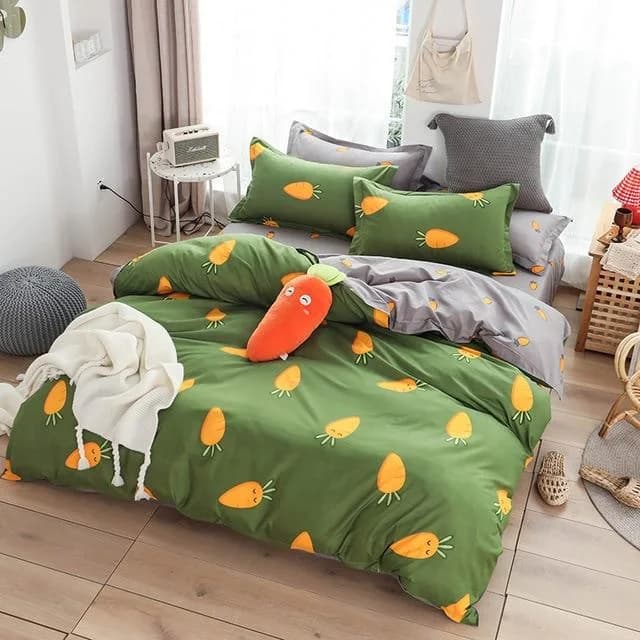
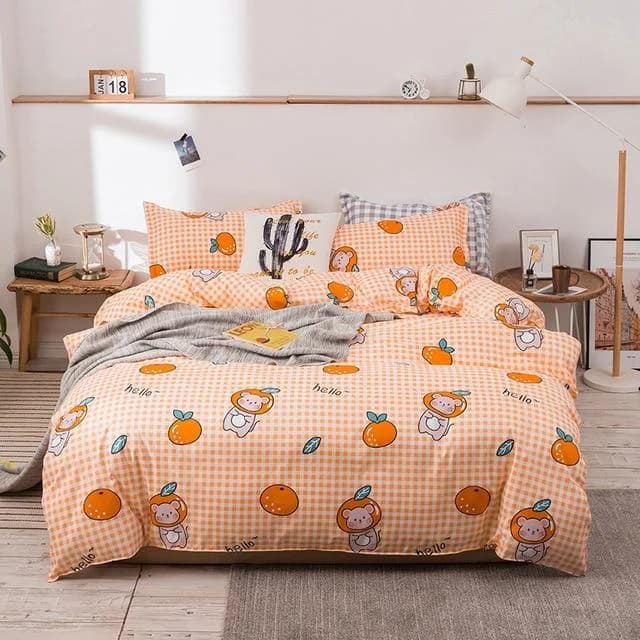
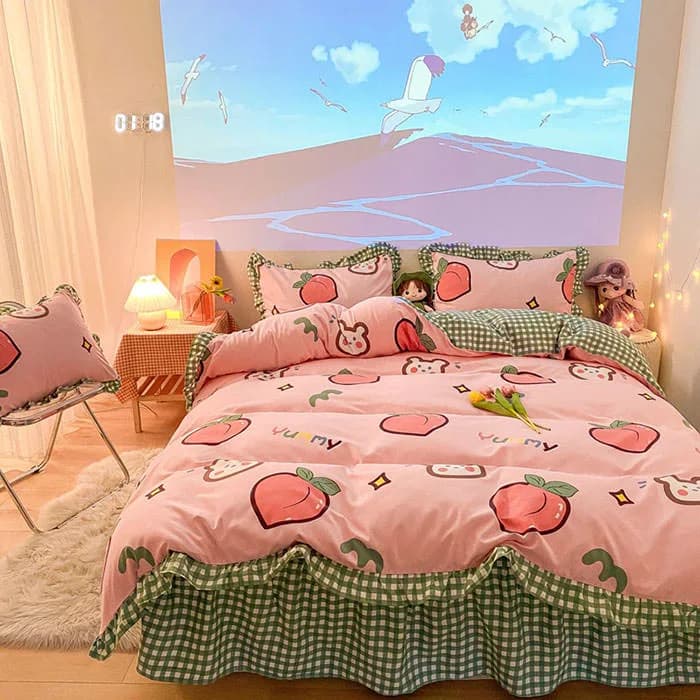
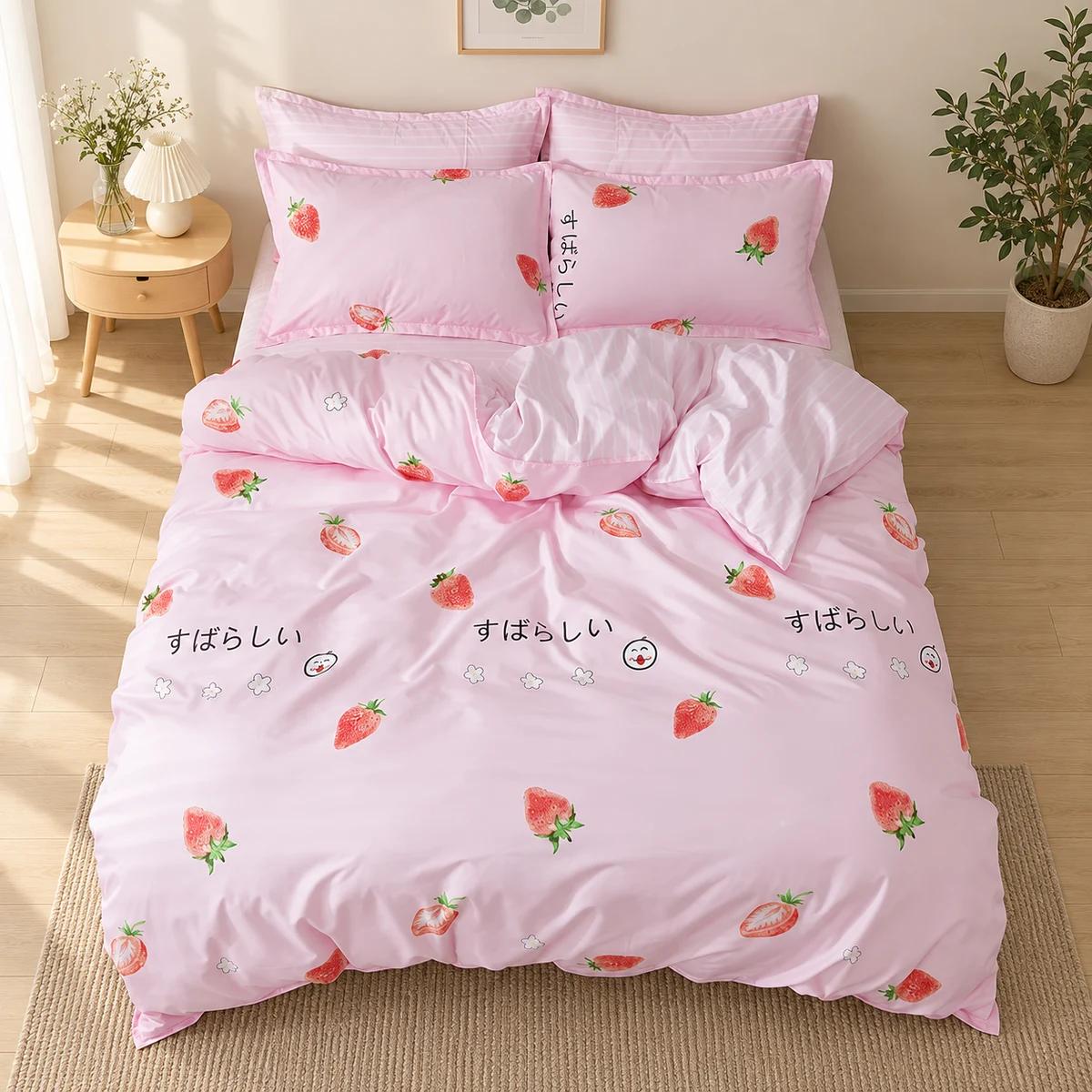
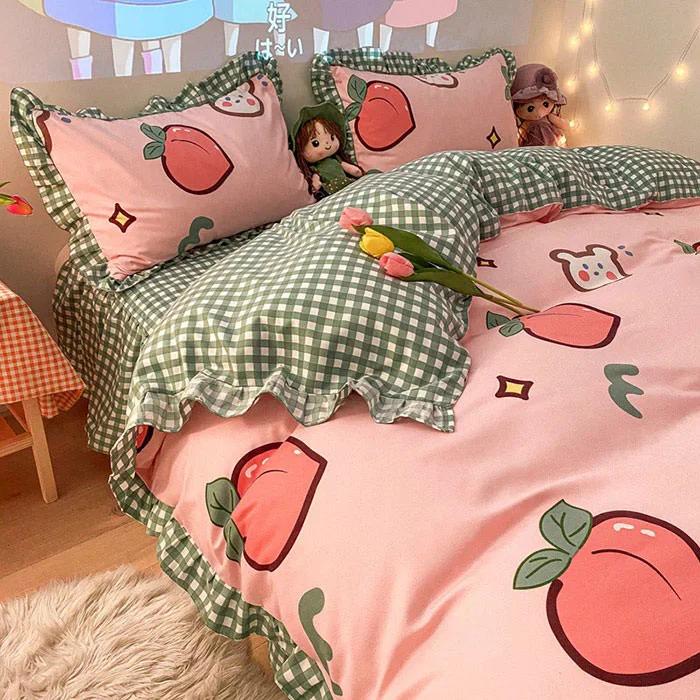
For soft pink and green, the Kawaii Peach Bedding Set is listed in a pink/green option, in Twin, Full and Queen, made of polyester. That gives you a ready-made two-colour scheme. The Kawaii Pink Strawberry Bed Set is listed as pictured, with sizes from Twin 3pcs up to King 4pcs, so look at the photos to see how much pink versus other colours shows.
If you want to browse by look, the Kawaii Bed Sets collection is the widest starting point. Pick one favourite, then stop shopping for patterns. The rest of the bed is about calming it down.

How Many Patterns a Small Room Can Take
The safe number is one big pattern and, at most, one small one. The big pattern is your duvet cover. The small one could be a gingham pillowcase or a tiny dot throw. Anything beyond that and the eye has nowhere to rest in a compact space.
Scale matters. If your main print has large fruit or characters, pair it with a tiny or very simple second pattern, or none at all. If your main print is small and repeating, you can sometimes use a slightly larger stripe, but keep it in the same colour family so it reads as one idea.
Solids do the heavy lifting. Plain sheets, a plain blanket and a plain pillow in a colour from the print make the pattern look intentional. A good habit: for every patterned item you add, make sure at least two nearby items are solid.
Pastel Palettes That Keep Space Feeling Open
Pastels tend to look lighter and less heavy than saturated shades, which helps in a tight room. A pink and cream bed, a mint and white bed, or a soft yellow and cream bed all feel airy because there is a lot of light colour holding the scheme together.
If you like that gentle look, the Pastel Bed Sets collection is a good place to compare tones. Look closely at the photos: some pastels lean warm, some cool. Keep to one temperature. Peachy pink with mint can work, but cool lavender with warm butter yellow can fight each other in small spaces.
Pastel does not mean flat. Add one slightly deeper shade, like a dusty rose next to pale pink, so the bed has some shape. Without it, a very pale bed can look washed out against pale walls.
Bright Palettes Without the Chaos
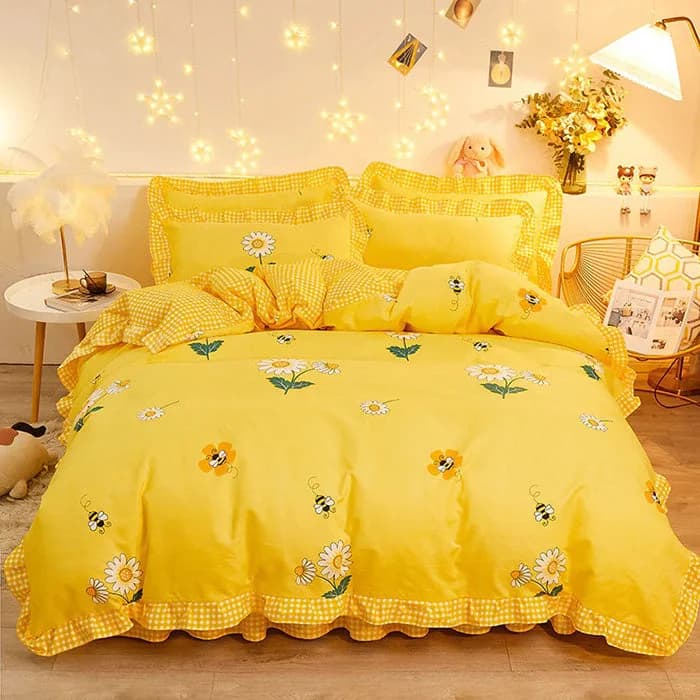
Love yellow? You can go bright in a small room if you narrow it down. The Honey Bee Aesthetic Bedding Set and the Sunflowers Aesthetic Bedding Set are both listed in yellow, in Twin, Full and Queen, and both are listed as 100% cotton. Pair either with white and one soft neutral like cream or light wood.
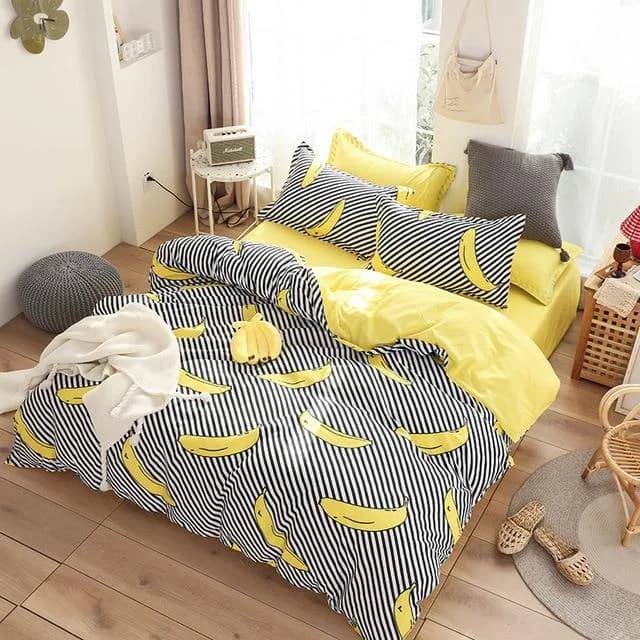
The trick with bright colours is to keep the second colour calm. Yellow plus white plus a little warm grey is restful. Yellow plus orange plus red plus green is a fruit stand. Choose the star, then keep supports pale or neutral.
Also consider your wall colour. Bright bedding against a pastel wall can feel crowded, while the same bedding against white or cream looks crisp. If you can't change the wall, let the bedding be the only saturated thing in view.


Using the Walls and Floor as Your Free Colour
In a small room, walls, rug and curtains count as part of your palette even if you never bought them as décor. Before adding anything, note their colours. A beige rug and white walls are quiet partners. A bright green wall is already one of your three colours.
If the walls are already coloured, pick bedding that shares that hue or sits neutral beside it. Example: pale blue walls with a pink and white bed means your three colours are blue, pink and white, and you're done. Add nothing else bold.
Floors matter too. Dark wood grounds a pastel bed nicely, while a patterned rug adds another pattern you may need to count. If the rug is busy, go plainer on the bedding sheets and pillows to balance it.
The Layering Order, Bottom to Top
Layer in this order so the bed looks tidy and the colours stack logically. First, the fitted sheet in a solid shade. Second, the flat sheet or lightweight blanket, if you use one, also solid. Third, the duvet or comforter with its patterned cover. Fourth, a folded throw across the lower third. Fifth, pillows, back to front.
Keep the patterned layer as the largest visible area. Sheets should peek out only as a thin edge, and the throw should be plain or a tiny print. That way the print is one clear block, not scattered across five layers.
Check your set contents before you plan. Pieces vary by listing, such as the Twin 3pcs versus 4pcs sizes on the strawberry set, so read the product page to see what is included and what you will need to add yourself.
Pillows and Plush: Where Accent Colour Lives
Pillows are where you spend your accent colour. Use two sleeping pillows in the set's cases, then one or two decorative ones in solid support colours. Three to four pillows is plenty in a small room. More starts to eat the bed.
A plush can be your tiny 10 percent. The Kawaii Cat Paw Pillow Plush is listed in gray, black, white and brown, in sizes S and M. White or gray reads as neutral against pink or yellow, while black or brown gives a stronger anchor. Pick the shade based on whether your bed needs softness or contrast.
Place the plush at one side, leaning against a pillow, not in the centre. Asymmetry feels relaxed, and it keeps the middle of the bed clear so the pattern still shows.
Matching Bed Size to Room Size
The size you pick changes how much pattern you see. A bigger bed in a small room means a bigger patterned surface, which can overwhelm. If you are between sizes and floor space is tight, choose the smaller one that still fits your mattress comfortably.
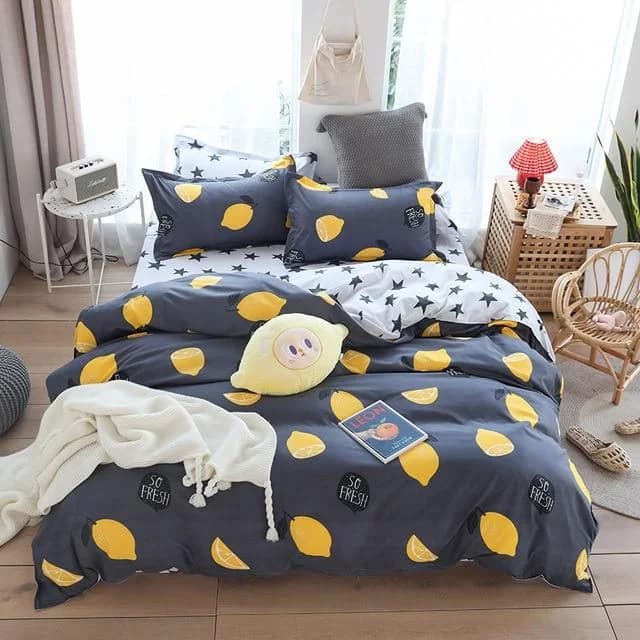
Sizes vary by listing. The Kawaii Funky Bunny Bed Set is listed in Twin, Full, Queen and King. The Kawaii Lemon Bed Set lists size choices including 150x200cm big, 150x200cm small, 180x220cm, 200x230cm and 220x240cm. Check the listing details and match the option measurements to your own mattress and duvet before ordering.
If your mattress is on the smaller side, a loud print on a small surface can actually be easier to live with. Whatever you choose, measure your bed first and compare to the listing instead of guessing.
Three Ready-Made Small Room Schemes
Scheme one, soft fruit: the Peach set in pink/green, white sheets, a cream throw, and a white cat paw plush. Colours: pink, green, cream. Scheme two, sunny: the Sunflowers set in yellow, white sheets, a light wood shelf and a gray plush. Colours: yellow, white, gray.
Scheme three, sweet and bold: the Gummy Bear Bedding Set in green/pink, polyester, in Twin to King. Keep the sheets white, skip other patterns, and let one small pink pillow echo the print. Colours: green, pink, white. Bold print, quiet everything else.
Each scheme follows the same pattern: one print, one solid base, one tiny accent. You can swap in your own favourite set and the formula still holds.
Pulling the Rest of the Room Together
Once the bed is sorted, the rest of the room should borrow from it rather than add new ideas. A lamp shade, a frame or a storage basket in one of your three colours ties things together. Browse the Aesthetic Bedroom collection for pieces, but only add what repeats your palette.
Keep surfaces clear. A small room with a nightstand covered in small items will feel busy even with calm bedding. Choose one or two things for display and tuck the rest into a box or drawer.
Lighting also changes colour. Warm bulbs make pinks and yellows look cosier, while cool ones make them crisper. Look at your bedding in the room's actual light before deciding it clashes.
Care, Comparing and Avoiding Fades in Your Plan
Check the care notes before you commit to a palette you will need to keep looking fresh. The peach, gummy bear, honey bee and sunflowers listings all state hand wash or machine wash on a gentle cycle with cold water, then sun dry or low tumble dry. Strawberry, lemon, bunny and plush listings don't give material details, so check the page and any label that arrives.
When comparing sets, line up four things: main colour, pattern scale, what pieces are included, and the sizes offered. Write them in a note for each candidate. The one that fits your three-colour plan with the fewest extras usually wins.
Light colours show marks more easily, so if you eat or work on your bed, consider a deeper support colour for the throw. Wash according to the listing, and avoid hot water since the instructions specify cold.
Final Checklist Before You Buy
Run through this before checkout. It takes five minutes and prevents most returns caused by a clashing or crowded room. Treat it as a quick filter rather than strict rules.
If you answer no to more than one item, rethink the extras instead of the main set. The star is usually fine; it is the add-ons that crowd a small room. You can always start with the set alone and add things slowly.
- Can I name my two or three colours in one sentence?
- Is there only one big pattern on the bed?
- Do I know my mattress size and the listed size I'm ordering?
- Have I checked which pieces come in the set?
- Are sheets and throw plain or very quietly printed?
- Do the walls and rug fit the palette?
- Is the accent (plush or pillow) limited to one or two items?
- Have I read the care notes for the set?
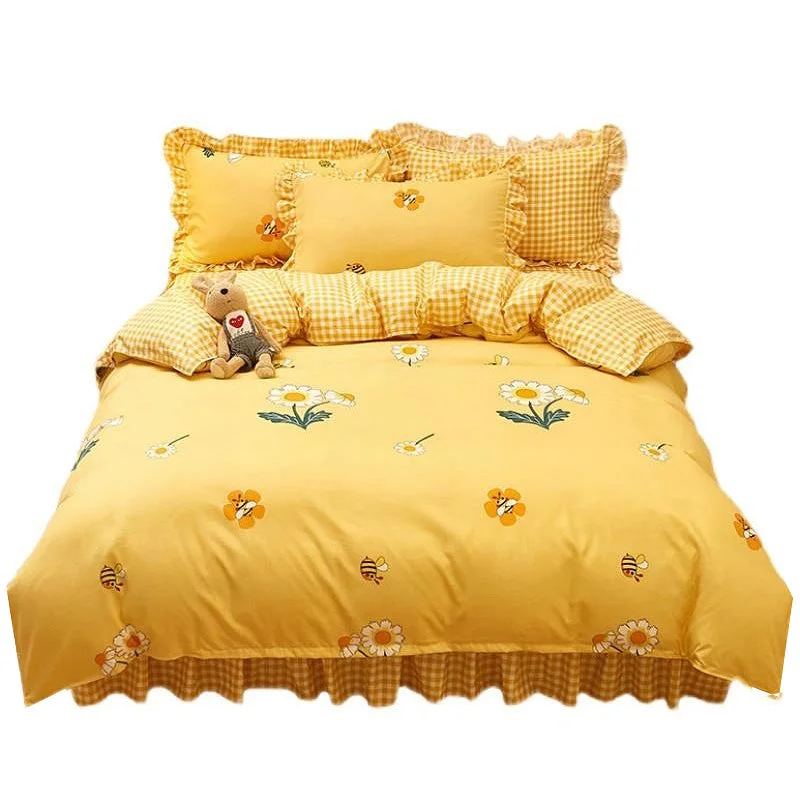
Compare the bedding beside your existing wall color
A product photo shows a color under the lighting used for that picture. Your room may have a warmer lamp, a cooler window or a wall color that changes how a pastel looks beside it. Use the listing as a reference, then compare the proposed palette with the largest things you already have: walls, curtains, bed frame and floor. You do not need to replace all of them to make a new bedding set feel at home.
Choose one connection you can repeat. Cream bedding can relate to a pale curtain; a small lilac detail can connect to a print above the bed. If your room already has several strong colors, a quieter bedding pattern can give your eyes a place to rest. If the room is mostly plain, a patterned duvet can become the main feature without adding more objects to the floor.
Separate the color decision from the size decision. Check the dimensions and included pieces for the selected bedding option. Names such as double, queen and king vary between markets, and a photograph showing several pillows does not confirm how many covers are included. Compare the stated measurements with your duvet and pillows, then ask for clarification if the option description leaves anything uncertain.