

80s
80s Jeans
Find authentic retro shapes with our 80s jeans selection. Explore distinct high waists, statement closures, straight cuts, and graphic accents across sizes S through 2XL. Compare listed fabric notes, individual size charts, and practical styling ideas to build balanced daily outfits. Free standard shipping on every order.
17 pieces to exploreFree standard shipping on every order
17 pieces






Your guide to 80s Jeans
How Should You Choose Leg Shapes and Waist Rises?
Finding your preferred denim profile starts with waistband elevation and leg geometry. Traditional retro silhouetteThe overall shape an outfit creates, from fitted to loose and layered.s lean on high-rise constructions that sit directly at the natural waistline. For an understated, balanced shape, the 90s Straight Leg Jeans offer a pure cotton build across sizes S through 2XL. Straight cuts drape cleanly downward from the hip, creating a steady vertical line that stays easy to style.
When you want visual interest at the waistline, asymmetrical cuts change the front profile. The Irregular Front High Waist Jeans offset the button fly, creating an angled baseline across sizes S to 2XL. This detailed waist pairs naturally with cropped knits or tucked shirts. Because this piece lacks a measurement chart, check the product photos and compare the fit with your favorite denim.
Consider where the hem settles around your footwear. Straight hems fall cleanly over low-top shoes, or you can roll them upward for a structured cuff. Comparing the front rise measurement with your torso length helps ensure the waistband rests securely against your ribcage or sits right at your hip bones, keeping your outfit balanced throughout the day.
Which Waistline Accents and Closures Fit Your Style?
If you want your trousers to serve as the visual centerpiece, look for integrated strap details or overlapping front closures. The Cross Waist Jeans feature an overlapping waistband on a slim cut in sizes S to 2XL. This construction provides a focal point without needing an external belt. Choosing cropped or tucked tops ensures the overlapping waistband remains visible during wear.
For alternative styling, consider hardware-focused designs like the Black Heart Buckle Jeans. Made from polyester in sizes S through XL, these jeans incorporate metal buckled hip straps directly into the waistband. Because this design includes a verified measurement chart, you can check specific waist dimensions before choosing. Hardware-heavy waistbands match cleanly with dark layers or simple monochrome tops.
When styling intricate closures, simplicity across your torso prevents visual conflict. Simple camisoles, ribbed tanks, and fitted tees keep the waist accents prominent without crowding your midsection. Selecting tops that terminate above the waistband ensures decorative buckles and crossed front flaps stay in full view, giving your retro denim room to function as the primary statement piece.
How Do You Balance Graphic Prints and Alternative Motifs?
Novelty prints and alternative patterns offer an easy way to move beyond traditional blue washes. The Melting Smiley Print Jeans bring vibrant graphic art onto a denim surface across sizes S through XL. Because graphic denim introduces strong focal colors, you can pull exact accent shades from the artwork into your accessories, jackets, or sneakers for a cohesive theme.
If you lean toward darker aesthetics, the Enchanted Pentagram Jeans feature geometric imagery printed on cotton elastic denim. This piece includes verified measurements across sizes S through 2XL, making waist and hip verification simple. When selecting printed pants, consider pattern placement: repeating vertical graphics draw the eye along the leg, while isolated thigh or knee graphics localize visual focus.
Patterned denim performs best when paired alongside neutral upper layers. Teaming graphic trousers with solid-colored basics from our 80s T-Shirts range prevents competing visual elements. An understated, solid-tone cotton top gives your illustrated trousers room to stand out cleanly. Grounding bold graphics with simple neutral shirts keeps your overall outfit practical for daily casual wear.
What Do Fabric Compositions Mean for Drape and Fit?
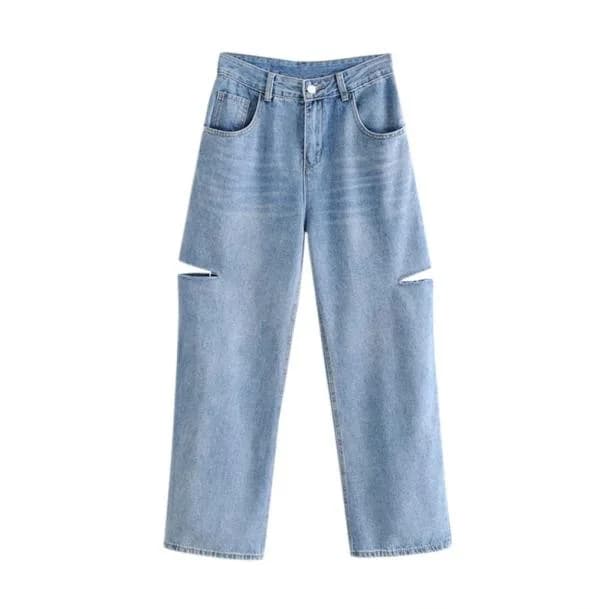
Fabric composition directly shapes how retro denim feels, drapes, and holds its silhouetteThe overall shape an outfit creates, from fitted to loose and layered. over time. Pure cotton denim, such as the Cutout 90s Fit Jeans, provides a structured perimeter that keeps straight leg lines crisp. While pure cotton will soften as you wear and wash it, it maintains its tailored form without excessive sagging around the knees and seat.
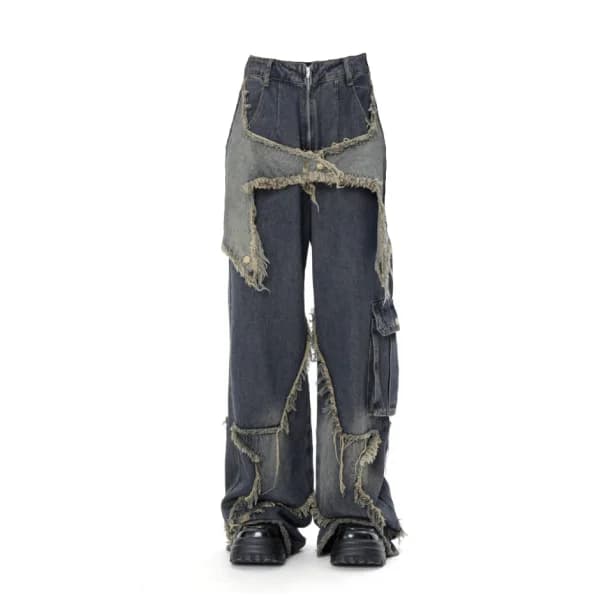
Blended textiles offer alternate textural properties. The Distressed Black Jeans blend cotton and polyester to create a structured look with a smooth drape across sizes S through L. Slashed thigh details introduce raw texture and added airflow, making distressed blends practical across changing seasons. Cutouts positioned along the mid-thigh avoid continuous knee bending strain during typical movement.
Other pieces, like the Enchanted Pentagram Jeans, incorporate cotton elastic denim for built-in fabric give. Always check individual item descriptions rather than assuming all denim behaves identically. While some pairs rely on rigid 100% cotton, others use synthetic fibers or elastic blends. Verifying fabric tags on each listing ensures you select a weave and flex profile that aligns with your preferences.
How Can You Measure Accurately When Size Charts Vary?
Sizing across vintage cuts is rarely standardized, so checking measurements is essential. Items like the Cutout 90s Fit Jeans, Black Heart Buckle Jeans, and 90s Straight Leg Jeans provide measurement charts directly on their listings. Compare your flat waist, hip, and inseam measurements with these figures rather than relying solely on arbitrary tag labels like S, M, or XL.
Other listings—including the Cross Waist Jeans, Melting Smiley Print Jeans, and Irregular Front High Waist Jeans—do not feature measurement charts. For these unlisted items, do not assume regular regional sizing. Instead, measure your best-fitting non-stretch denim laid flat on a table. Measure straight across the waistband, double the figure for total waist circumference, and evaluate front rise depth.
Remember to account for tucked layers when verifying your waist dimensions. Tucking heavy cotton jerseys or knits requires slightly more room at the waistband than wearing lightweight camisoles. Measure your favorite high-waist pants flat across the waistband to establish a dependable reference baseline before placing your order. Standard shipping is free on every order. Priority shipping is available at checkout.
How Do You Balance Proportions with Tops and Sweaters?
Retro denim styling relies heavily on proportional contrast: wide or straight denim legs pair well with close-fitting tops, while structured high waists support oversized sweaters. If you favor straight cuts, try fitted basics from our 80s Tops selection. Fitted bodysuits and snug ribbed knits highlight the natural waistline without creating awkward fabric gathering beneath the belt loops.
If you want to leave statement closures completely exposed, browse our 80s Crop Tops for hemlines that sit neatly above the waistband. For cooler weather, looser options from our 80s Sweaters collection can be loosely front-tucked into your waistband. This partial tuck reveals front button details or buckled accents while leaving the back loose.
Outerwear length changes how high-waisted denim frames your frame. A cropped jacket ending at the hip emphasizes high-rise proportions. Alternatively, wearing a relaxed, unbuttoned jacket creates parallel vertical lines down your torso. Keeping your inner shirt hem tucked or cropped preserves the elevated waistline of your denim regardless of how many outer jackets you layer on top.
Which Footwear Complements Straight and Distressed Hems?
Footwear selection defines whether your denim feels casual, sporty, or alternative. Straight-leg jeans pair naturally with footwear from our 80s Shoes collection. Low-top retro trainers and chunky sneakers provide a stable visual anchor beneath wider leg cuffs, keeping the fabric from dragging while producing a classic relaxed finish suited for regular city wear.
If you are styling distressed, black, or hardware-accented denim, combat boots and platform boots introduce striking contrast. Slim-leg denim can tuck smoothly inside mid-calf boot shafts, emphasizing the leg taper while guarding hems against street puddles. Straight-cut legs drape cleanly over the ankles of lace-up boots, creating an unbroken vertical line that elongates the lower leg.
Check leg opening widths against your shoe collar height before heading out. Loose straight hems hang naturally over low sneaker profiles without stacking awkwardly. For bulkier boots, cuffing the hems once or twice keeps the ankle zone tidy. Pairing substantial shoe soles with wider denim cuffs maintains balanced proportions and protects your pant hems from street friction.
How Should You Coordinate Bags and Jewelry with Denim?
Accessories tie a retro outfit together without getting in the way of your clothing. Compact shoulder bags and structured crossbody options from our 80s Bags selection keep your hands free while complementing high-waisted silhouetteThe overall shape an outfit creates, from fitted to loose and layered.s. Compact shoulder straps keep the bag close to your torso, preventing it from covering up asymmetrical waistbands or decorative hip buckles.
Jewelry should echo the hardware tones on your denim. If your jeans feature metallic buckles or silver rivets, coordinate your look using pieces from our 80s Earrings collection. Polished silver studs, angular shapes, and drop earrings mirror the metallic accents on your trousers, creating a cohesive visual link between your face and your denim hardware.
Explore additional complementary aesthetics across our 80s Aesthetic Clothes range, or browse alternative bottoms in our 80s Pants category. Standard shipping is free on every order. Priority shipping is available at checkout. Matching your jewelry metal to your denim rivets and buckles produces an intentional, well-coordinated look for any occasion.
How Do You Care for Printed and Distressed Denim at Home?
Caring for detailed denim properly helps maintain graphic prints, raw hems, and specialized hardware over regular wear cycles. For screen-printed garments like the Melting Smiley Print Jeans, always turn the pants inside out prior to washing. This shields the printed face from direct drum friction, preserving the bold graphic lines and keeping the colors bright over time.
Distressed garments and cutouts, such as those on the Cutout 90s Fit Jeans and Distressed Black Jeans, benefit from gentle wash cycles or dedicated mesh laundry bags. Enclosing distressed denim protects raw edges and fraying fibers from tangling around machine agitators or catching on zipper teeth. Avoid high-heat drying cycles to prevent uncontrolled shrinkage and premature fiber breakdown.
For pieces featuring integrated metal hardware, like the Black Heart Buckle Jeans, fasten all straps and buckles before laundering. Fastening the hardware stops metal components from striking the washer drum or catching on delicate top fabrics in the same load. Air drying your denim flat or on a sturdy hanger preserves original inseam lengths and maintains intentional cutout shapes.