
Written by the Kawaii Vibe editorial team. Journal scenes are original AI-generated editorial illustrations; product cards show items available to shop.
A name can stay with you because of its sound, a character you love, or the picture it brings to mind. If you're collecting cute Japanese names for a fictional character, a pet or a notebook shortlist, start with that spark. Then spend a little time with the spelling. There's more to a name than a one-line English translation.
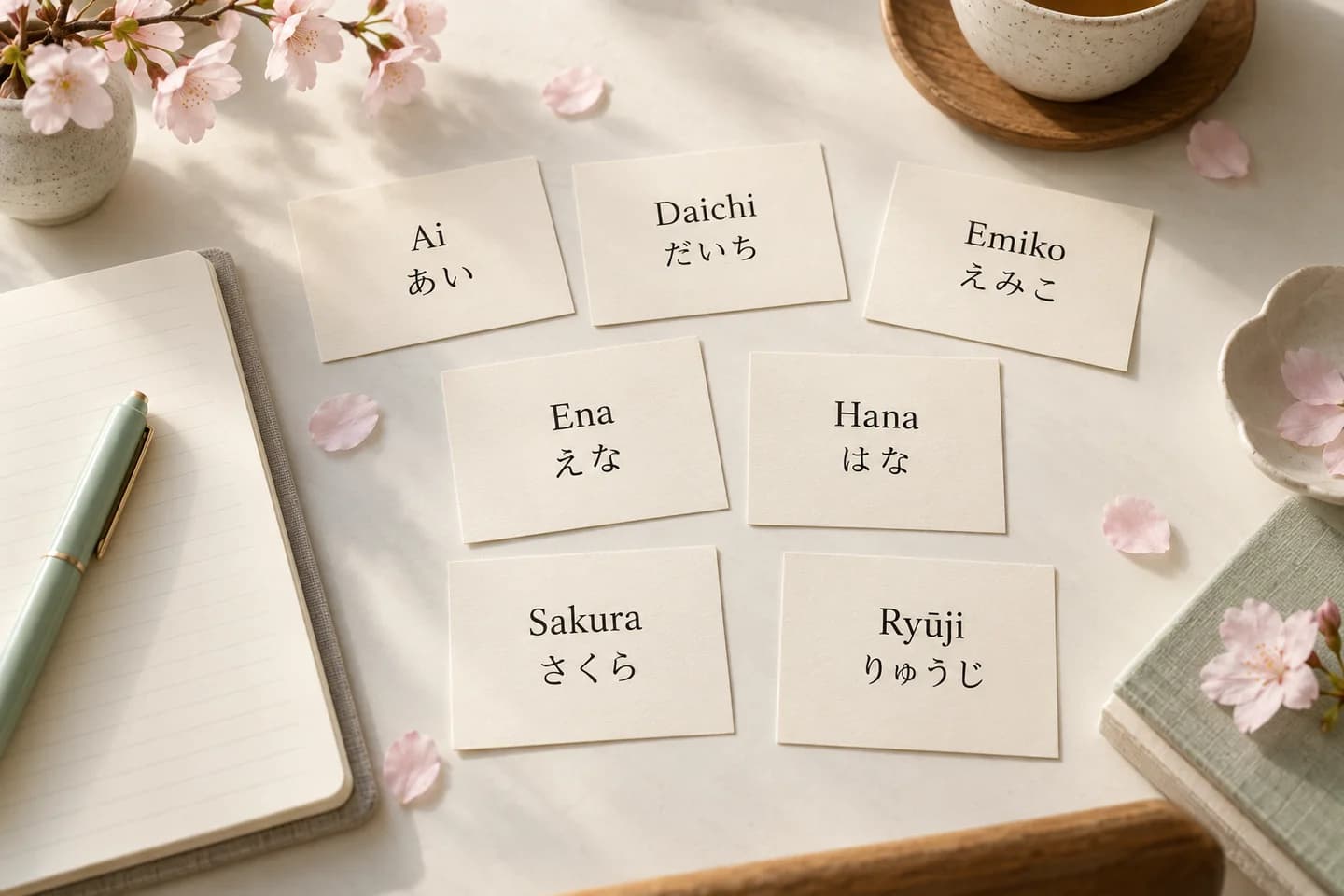
Here are seven names to explore: Ai, Daichi, Emiko, Ena, Hana, Sakura and Ryūji. You'll find the kana reading for each, a few clearly labeled kanji examples, and small exercises to help you compare them. This is a selection of names to enjoy and investigate, rather than a popularity ranking.
A quick guide to sound, spelling and meaning
Japanese names can share a reading while using different written forms. Roman letters tell you a pronunciation to look into; they don't automatically identify the characters. Kana records the reading, while a particular kanji spelling can bring particular meanings. For a real person's name, use the spelling and pronunciation that person gives you.
The written examples below belong to their particular spellings. For example, 愛 carries the meaning of love, but seeing the Roman letters Ai doesn't prove that someone writes their name 愛. Keeping a reading and its written example together lets you appreciate the association without giving every person with that reading the same translation.
- Ai — あい; written example 愛, love.
- Daichi — だいち; written example 大地, earth or ground.
- Emiko — えみこ; check the actual characters for a meaning.
- Ena — えな; check the actual characters for a meaning.
- Hana — はな; written example 花, flower.
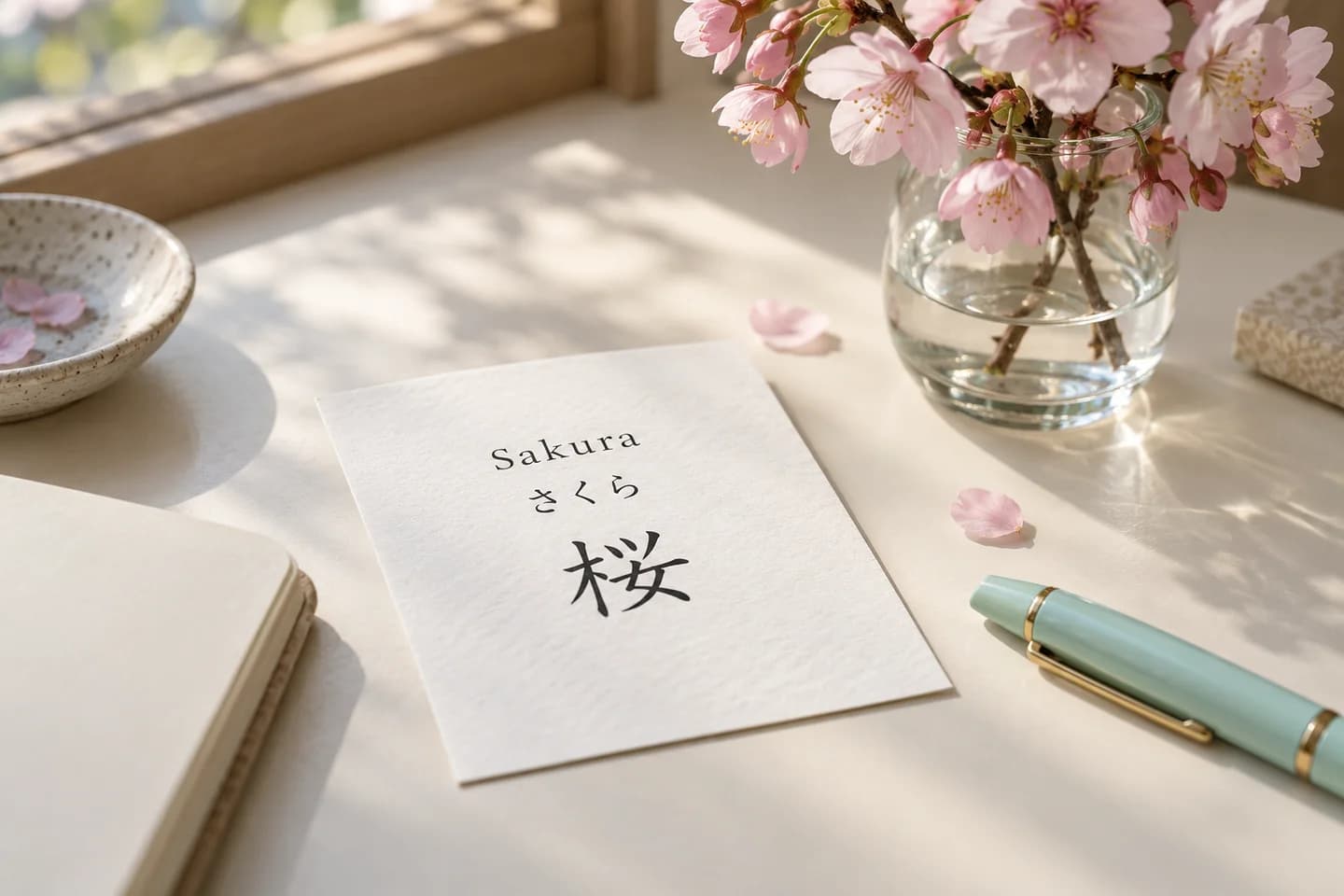
- Sakura — さくら; written example 桜, cherry or cherry tree.
- Ryūji — りゅうじ; also typed Ryuji; check the actual characters for a meaning.
Ai: a short reading with a love association
Reading: Ai, あい. Written example: 愛. If the love association is what first drew you to Ai, keep that character beside the name in your notes. The Kanjipedia entry for 愛 describes meanings around love, affection and cherishing. The connection belongs to 愛; another spelling needs its own explanation.
For a fictional character, try Ai in two ordinary sentences before writing a long character profile. 'Ai left a note on the kitchen table.' 'I saved a seat for Ai.' Read them aloud and see whether you enjoy the name in everyday dialogue as much as on a decorative name card. A favorite should work beyond its first impression.
You might put a small heart beside the 愛 example in your notebook as a personal memory aid. Keep the decoration separate from your character's personality: someone named Ai doesn't have to be sweet, romantic or gentle. Let the character's choices do that work, and let the name remain a name.
Daichi: exploring the earth and ground example
Reading: Daichi, だいち. Written example: 大地. In this example, 大 contributes large or great, and 地 means earth or ground. Together, 大地 refers to earth or ground. You can explore the second character in Kanjipedia's entry for 地, which also lists 大地 among its examples.
A useful way to compare Daichi with shorter choices is to write all of them in the same type of sentence. Place Daichi, Ai and Ena in a greeting, a line of dialogue and a notebook heading. Notice which one you naturally want to say again. You're comparing your response to the readings, not deciding which name has the best personality.
If 大地 appeals to you, a landscape sketch can make a lovely visual note beside it. Label that sketch as your own association. Earth imagery might inspire a story setting, a palette or a journal border, but it doesn't establish that a person called Daichi is strong, dependable or connected to nature.
Emiko: give the full reading room on your shortlist
Reading: Emiko, えみこ. Keep the full reading on the page while you explore it. It's tempting to jump straight to an attractive English meaning, especially when a name website supplies one without the original characters. For Emiko, choose the sound first and research a particular written form separately if your project needs one.
Try a character-note exercise with three details that have nothing to do with the name: what the character wants, what they keep in a bag, and what they say when they're nervous. Then put Emiko at the top. If the name still feels right after the person has become more specific, that's a better starting point than a meaning chosen to dictate every trait.
For a pet-name shortlist, test how the full name feels in the phrases you'll actually use at home. You can also write the kana slowly as え・み・こ to keep track of the sequence. That is a writing aid, not an instruction to add English-style stress or turn each part into a separate name.
Ena: a choice you can enjoy for its sound
Reading: Ena, えな. You don't need an elaborate translation to like a name. If Ena catches your ear, write down what you enjoy about saying or seeing it. A simple note such as 'I like this beside my character's surname' is more useful than borrowing an unrelated meaning from a similarly spelled name in another language.
Put Ena and Hana on separate cards and leave both visible while you work on something else. Later, return to them without looking at your first choice. Which one still catches your attention? This is a small preference exercise, and its value is personal: it won't tell you anything about how the names rank in Japan.
If you're keeping several languages in the same notebook, give each entry its own language label. Similar Roman-letter spellings can lead you down different etymological paths. A dedicated line for Ena's Japanese reading, えな, helps you keep that entry separate from another name you may encounter in a different naming tradition.
Hana: keep the flower example beside the name
Reading: Hana, はな. Written example: 花, flower. The floral association is easy to remember when you keep 花 on the same line. Kanjipedia's discussion of はな distinguishes written forms associated with the sound. That is a helpful reminder to copy the characters when you're recording a meaning.
For a journal page, try writing Hana once in Roman letters and once in kana, with a small floral border around the entry. Leave space underneath for the exact written form if you're researching a real or fictional person. The border makes the page yours; it doesn't add another meaning to the name.
If Hana and Sakura both appeal to you because of flowers, compare the readings before decorating either page. Write the same sentence with each and say both aloud. You may find that your first choice comes from the sound rather than the botanical association. Either reason can belong in your personal notes.

Sakura: a cherry-tree association to explore
Reading: Sakura, さくら. Written example: 桜. 桜 refers to cherry or a cherry tree, which brings the familiar association with its blossoms. The National Institute for Japanese Language and Linguistics dictionary entry for さくら is a reference for the word. A particular person's spelling remains a separate detail.
If the blossom image is what you love, make a tiny two-part entry: the dictionary note on one side and your personal inspiration on the other. The first might say '桜: cherry/cherry tree.' The second might hold a pink swatch, a photograph or a memory of a walk. Both can matter without becoming the same kind of information.
For a character, try Sakura in a scene that has no flowers in it. Have the character miss a bus, make a joke or forget a shopping list. It's an easy way to see whether you like the name as part of an ordinary life, beyond a beautifully arranged mood board.
Ryūji: keep track of the long vowel
Reading: Ryūji, りゅうじ. Plain-text form: Ryuji. The mark above ū represents a long vowel. If your keyboard or username field doesn't support it, keep the kana alongside your research notes so the reading isn't lost. Neither Roman-letter form tells you which kanji a particular person uses.
For a writing project, decide how you'll present the name consistently. A manuscript with Ryūji in one chapter and Ryuji in the next may leave a reader wondering whether you mean the same person. You can keep a small spelling sheet for character names, including the form used in dialogue tags, headings and your own notes.
Don't choose characters simply because a dictionary gives them dramatic individual meanings. If you want a particular kanji spelling to be part of a story, check its reading as well as its meanings with a knowledgeable speaker or a reliable name reference. You can keep Ryūji on the sound shortlist while you do that research.

How to use the kana without guessing English rhymes
The kana lines help you keep the reading attached to the name. For a copying exercise, separate them as あ・い, だ・い・ち, え・み・こ, え・な, は・な and さ・く・ら. For Ryūji, keep りゅう together before じ. These divisions are a visual aid, rather than English syllable or stress instructions.
If pronunciation matters to your project, listen to a reliable recording instead of relying on an English rhyme written beside the name. English accents vary, and a rhyme that helps one reader may send another in the wrong direction. For a real person, their own introduction is the most useful starting point.
When copying unfamiliar characters, enlarge the text and work slowly. Leave your first attempt beside the reference so you can compare shapes instead of repeatedly overwriting them. A line in a kawaii notebook can hold the reading, the spelling and a short note without turning the page into a crowded study sheet.
Choose for a character or pet, then try it in context
For a character, start with the story you're actually writing. Write a short exchange between two people and use your candidate name several times. Does it sit comfortably beside the other character names? Can you distinguish everyone while reading quickly? Change one name at a time so you can tell which choice made the passage clearer.
For a pet, try the complete name in the ordinary phrases you'll use. You might practice saying it from another room, writing it on a care note, or introducing the pet to a friend. This isn't a prediction about how an animal will respond; it's a way to check whether you enjoy using the name yourself.
Keep two or three finalists for a little while. A name that looks wonderful on a list may feel different when you use it repeatedly. There is no need to force a decision after one browsing session, and a meaningful English gloss doesn't have to outweigh a reading you simply like better.

A notebook exercise: compare Hana, Ena and Sakura
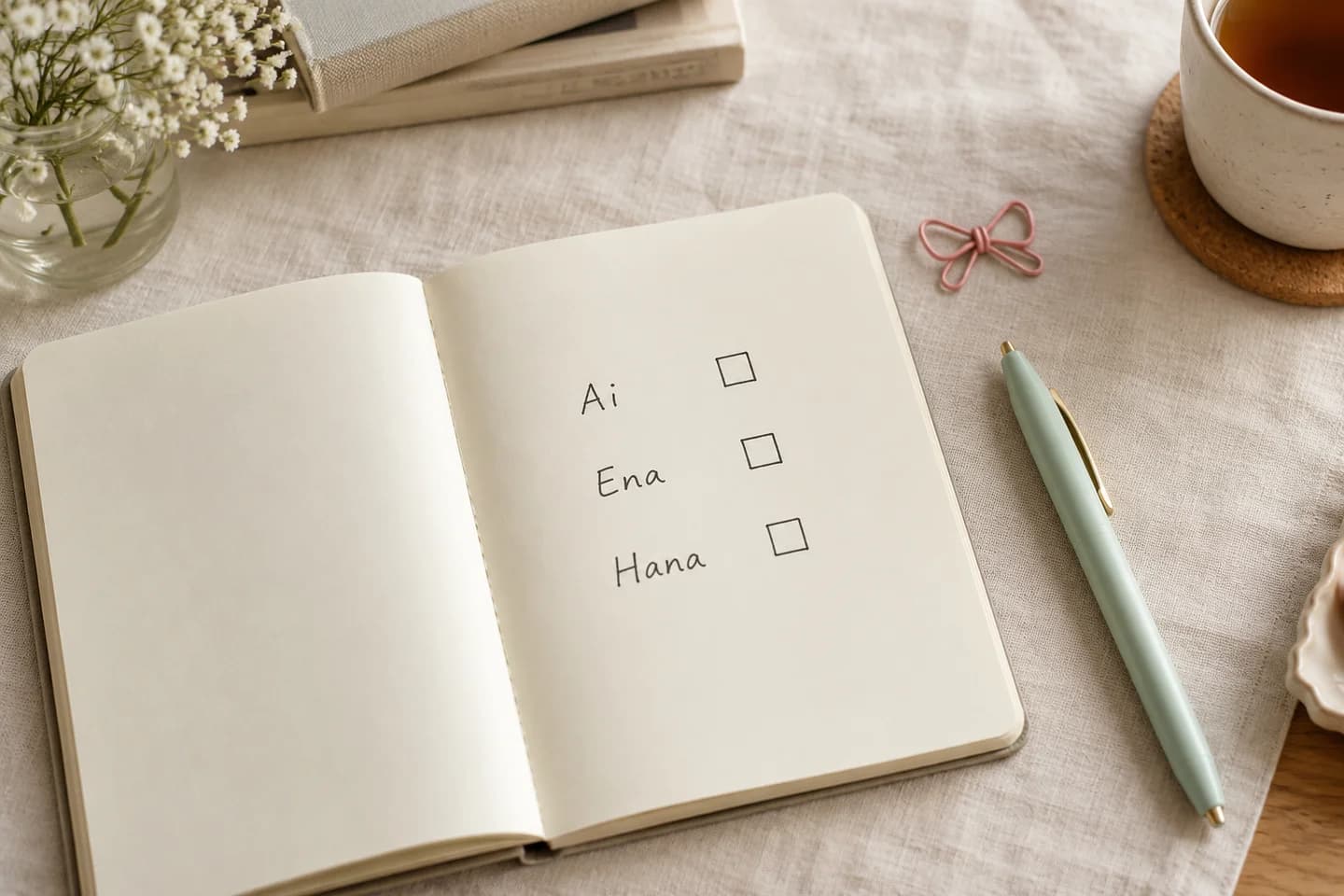
Draw three columns and put Hana, Ena and Sakura at the top. Under each, add the kana and a sentence using the name. Give every column the same amount of space. That prevents the choice with the most decorative notes from looking automatically more appealing than the one you've only just started exploring.
Next, add a line called 'Why I like it.' For Hana, that could be your interest in the 花 example. For Ena, it might be the sound beside a surname. For Sakura, it could be a personal memory of blossoms. These are examples of your preferences, so you can write something completely different.
Finish with 'What I still want to check.' You might want pronunciation audio, the spelling used by an author, or more time testing the name in dialogue. Keep sound, spelling and personal association on separate lines. It makes your notes easier to revisit when your shortlist changes.
Common questions about these Japanese names
Does Ai always mean love, or Hana always mean flower? Those meanings belong to the examples 愛 and 花. A Roman-letter name alone doesn't establish its written form. Keeping the character beside the explanation is a compact way to remember exactly which example you liked and why.
What about meanings such as 'great first son,' 'gift from God,' 'smiling child' or 'dragon man'? Don't attach these automatically to Daichi, Ena, Emiko or Ryūji. A particular written form needs its own explanation; 大地 gives an earth/ground example for Daichi. Similar sounds across languages don't establish the same etymology.
Are these the most popular Japanese names? This guide doesn't make that claim. It brings together seven readings for a personal shortlist. Popularity needs a dated dataset with a clear population and method, which is a different question from whether you enjoy a name for your character, pet or journal.
Make your name notebook easy to come back to
Use one main pen for the name and a second color for your own associations. If you enjoy decorating, kawaii stickers can mark favorites without covering the kana or source notes. Leave enough blank space to add a corrected spelling later; a useful notebook can change as you learn.
Choose kawaii pens by the options and writing details shown on each product page, and compare notebook dimensions before buying. A small book can work for shortlists, while a larger page gives you more room for character sketches and side-by-side comparisons. The right choice is the one you'll actually keep using.
You can browse the wider kawaii stationery collection for a notebook, a pencil case or a small desk companion. Start with what helps you keep your notes clear. A few favorite names, their readings and your own thoughtful observations are enough to make the first page worth returning to.
