Created by the Kawaii Vibe editorial team. Our named style desks are editorial personas. Product details and availability can change.
Oshare kei is a Japanese street style that mixes Visual kei's rock edge with bright color, cute prints and lots of accessories. Think dark pieces with neon pops, or pop-bright layers with studs and chains. The word oshare means fashionable or stylish, and the look is all about playing with contrast.
If you're getting dressed with this in mind, here's the short version. Pick one dark base, add one or two loud colors, then layer small details like socks, bracelets and a bold phone case. This guide covers where the style comes from, how to build outfits for different weather, what to avoid, and how to size things so you actually feel good wearing them.
One note first. Oshare kei is tied to a music scene, but you don't need to be in a band or love the music to enjoy the clothes. People wear kei-inspired fashion just because they like how it looks.
The quick answer: what Oshare kei looks like
Oshare kei is a branch of Visual kei, the Japanese rock-and-fashion scene known for dramatic looks. Where classic Visual kei often leans dark and moody, Oshare kei leans cheerful. The colors are brighter, the prints are cuter, and the mood is more playful.
The easiest way to spot it is the clash. A black jacket with a neon tee. Rainbow stripes with ripped denim. A fluffy layer over a studded belt. Nothing is meant to match neatly. It's meant to feel lively and a bit rebellious at the same time.
Where the style comes from
Oshare kei grew out of the Visual kei scene in Japan, and it's usually linked with bands from the 2000s. Early on, the look was closer to regular Visual kei. Over time it got brighter, and the music picked up more pop, dance and electronic flavors alongside the rock and punk roots.
Bands often named in connection with the style include An Cafe, Charlotte, SuG and Canzel. Their looks varied a lot. One group might lean into school-uniform ideas, while another goes for glam or a futuristic feel. That's a useful reminder: Oshare kei isn't one fixed uniform. It's a mood with plenty of room for personal taste.
If you want the darker parent style, our Grunge and Dark Academia edits are handy places to borrow base pieces from.

How it differs from Decora, Fairy kei and Visual kei
These styles overlap, so it helps to separate them by feel. Decora piles on bright accessories until everything is covered in color. Fairy kei is soft and pastel. Classic Visual kei often goes dramatic and dark.
Oshare kei sits between them. It borrows the cute prints and accessories, but keeps the rock edge. Neon and strong primary colors show up more than baby pastels. Dark layers, chains and studs stop things from feeling sugary.
A fast test: if your outfit is all pastel and soft, it's closer to Fairy kei. If it's covered head to toe in accessories, it's Decora territory. If you've got black, a neon hit and a bit of hardware, you're in Oshare kei land. For softer cousins, browse Pastel Goth and Soft Girl.
The building blocks of an Oshare kei outfit
You don't need a costume. A few repeatable pieces do most of the work.
Start with the base, then add contrast, then add small details. That order keeps things balanced and stops you from grabbing everything at once.
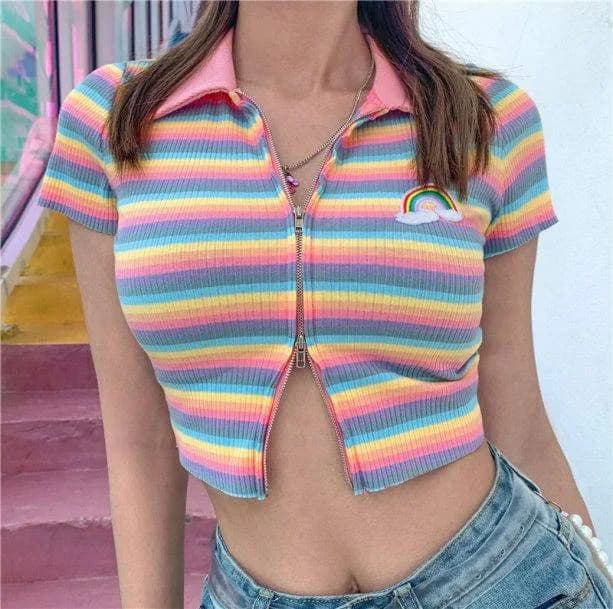
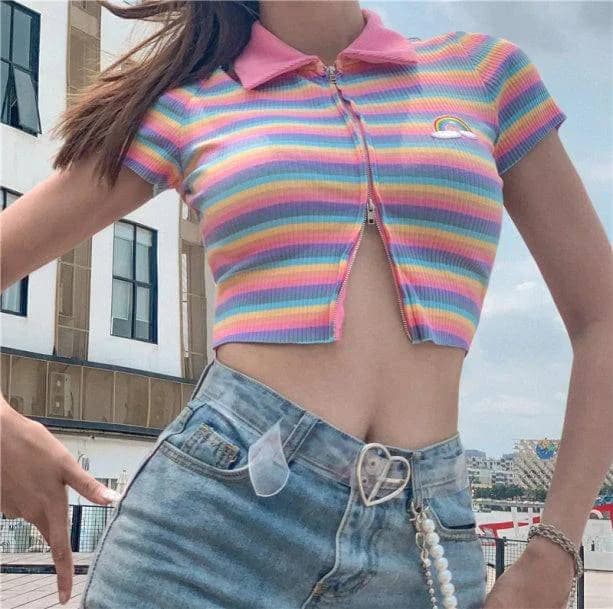
Starting with a distinct top gives you a clear focal point before adding accessories. For example, wearing the multi-hued Rainbow Zipper Up Top creates instant contrast when paired with dark trousers or layered over a neutral tee. You can discover more styling pieces across our Oshare Kei Clothes collection to begin testing different silhouetteThe overall shape an outfit creates, from fitted to loose and layered.s.
- A dark anchor: black jeans, ripped denim, a leather-look jacket or a plain black top.
- A bright hit: neon pink, electric blue, acid yellow or rainbow stripes.
- A cute print: characters, polka dots, animal print or playful slogans.
- Texture on top: a fluffy jacket or cardigan adds softness against harder pieces.
- Hardware: studded bracelets, chokers, cuffs or a chain belt.
- Legwear: knee-high socks, stockings or arm warmers to repeat a color.
- Hair and makeup: bright streaks, clips, or colorful eyeshadow with defined liner.

Color rules that keep clashing from looking messy
Clashing works best when it's planned. Choose one dark color and two bright ones. That's usually enough. Three or four loud shades start to fight each other.
Repeat each bright color at least twice. If you wear a pink top, put pink in your socks or a bracelet. Repetition makes a clash look deliberate.
Use black or white as a resting place. A black skirt or pair of jeans gives the eye a break between bright pieces. If you want a more graphic look, try black and white stripes beside one neon shade.
If neon feels like too much near your face, put it lower down. Bright socks or a bold phone case give you the color without a full-on glow.
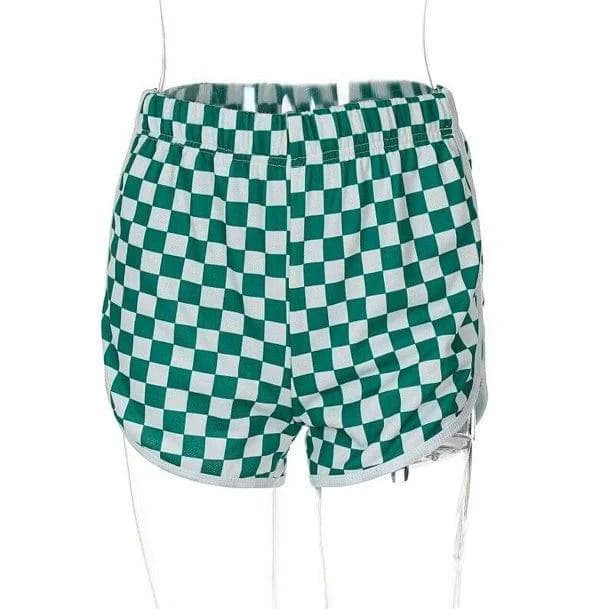
Balancing vivid prints against black or neutral pieces helps keep high-contrast looks intentional. If you pick the Y2K Green Checkered Shorts, you might ground the green pattern with a dark graphic tee or muted jacket found in Oshare Kei Tops. This combination lets the checkered print lead while preventing color chaos.

Outfit ideas for warm, mild and cold weather
Here are three combinations you can adjust to your own wardrobe.
Warm weather: Start with the What’s Wrong With Me Baby Tee, which is made from cotton and polyester. Pair it with black shorts or a pleated skirt. Add the What's For Snack Today Socks, made of cotton, and chunky sneakers. Finish with a choker and a few bracelets. It's light, but the contrast still reads as Oshare kei.
Mild weather: Wear ripped black jeans, a striped long-sleeve under a graphic tee, and a patterned or fluffy jacket. Add arm warmers or a wrist scarf for color. Boots or platform shoes help ground all the brightness.
Cold weather: Layer the All We Need Is Love Hoodie, made of polyester, under a dark coat. Add tights, then knee-high socks like the Do What You Want Socks, which are cotton. Mittens or a beanie in a bright shade bring the color back when the coat covers everything.
Overalls offer an adaptable base for shifting temperatures. The 90s Striped Overalls pair naturally over a fitted long-sleeve tee on cooler afternoons, and you can layer them beneath knitwear from Oshare Kei Cardigans. When the weather warms up, swap to a short-sleeve shirt underneath to keep the silhouetteThe overall shape an outfit creates, from fitted to loose and layered. light.

Comfort-first versions of the look
You can wear this style without feeling weighed down. Pick the parts you enjoy and leave the rest.
If you hate heavy layers, put the personality in small things. A plain black tee and jeans become Oshare kei with bright socks, a cute-print phone case and one or two cuffs. The You Need To Be iPhone Case and the All You Need Is Love AirPods Case are easy ways to add a statement without changing your outfit.
If you don't like tight clothes, go oversized on top and keep the bottom half simple. A roomy hoodie with leggings or straight jeans feels relaxed but still looks styled.
For long days, choose accessories you can forget about. Skip anything that digs, pinches or gets caught on bags. Save the biggest piles of jewelry for short outings.
Ways to adapt it for school, work or errands
Not every day allows full color. That's fine. Oshare kei works in small doses.
For a quieter setting, wear mostly black and add one bright item, such as socks, a hair clip or a printed tee under a cardigan. For a casual office, try dark trousers, a plain top and one playful accessory. Keep studs and chains minimal if you need a toned-down look.
For weekends, build up. Add the fluffy jacket, the striped layer, the extra bracelets. Having a range means the style fits your life, rather than the other way around.
If you like mixing in other trends, Y2K pieces pair well with bright prints, and the wider Harajuku & Kawaii range gives you more cute-print options.
Fit and measurement guidance
Layered looks need room to move, so check measurements before you buy. Grab a tape measure and note your bust or chest, waist, hips and, for tops, shoulder width. Compare them with the size chart on each product page, since cuts can vary.
For layeringWearing pieces over or under one another to add depth, warmth or contrast., think about what goes underneath. If you plan to wear a hoodie over a long sleeve, you may want your usual size or one up, depending on the cut. The All We Need Is Love Hoodie is listed in sizes S to 4XL, and the What’s Wrong With Me Baby Tee runs XS to XL. Baby tees are usually cropped and fitted, so check the length if you prefer more coverage.
Socks listed as one size are meant to stretch, but always check the product page for details. For phone and AirPods cases, match your exact model. The iPhone case is listed for iPhone 11 through 14 models, and the AirPods case for AirPods 1/2, Pro and 3. Fit can never be guaranteed, so use the chart and read the description closely.
Common pitfalls to avoid
Too many focal points. If the jacket, hair, makeup and accessories are all shouting, nothing stands out. Choose two stars and let the rest support them.
Matching everything. Oshare kei likes contrast. A perfectly matched set can end up looking like a different style.
Ignoring shoes. Delicate flats can make a bold outfit feel unfinished. Boots, platforms or chunky sneakers balance the volume.
Copying a look exactly. Photos of bands are inspiration, not rules. Take the color play and attitude, then adjust for your body, budget and daily plans.
Treating it as a costume. The best versions look like your own wardrobe with extra play. If it feels like dress-up every time, scale it down.
FAQs
Is Oshare kei the same as Visual kei? No. It's a branch of it. It shares the dramatic spirit but uses brighter colors and cuter themes.
Do I need to like the music? No. Plenty of people wear kei-inspired fashion just for the clothes. The music is part of the history, though, so it's fun to explore if you're curious.
Is it only for certain genders? No. The style is often described as androgynous, and you can wear it however feels right to you.
What's the easiest first step? Add bright socks to a black outfit. Then try a fluffy jacket or a stack of bracelets.
Can I mix it with other aesthetics? Yes. It blends well with grunge, Y2K and pastel goth. Browse the Aesthetic Clothing collection to see what fits your taste, or check Cottagecore if you want to try a softer contrast.
A 5-minute outfit checklist before you leave the house
Use this quick check when you've put an outfit together and aren't sure if it works. It's built to catch the usual problems, such as too much color or no clear focus, without making you start over.
Run through the questions in order. If you answer no to any of them, change just that one thing and check again. You rarely need a full redo.
- Do I have one dark anchor? If not, swap one bright piece for black, dark denim or a plain dark layer.
- Am I using no more than two loud colors? If there are three or more, pick your favorites and replace the rest with black or white.
- Does each bright color show up twice? Add socks, a hair clip, a bracelet or a bag charm to repeat it.
- Do I have two stars only? Decide which two things get attention (for example the jacket and the socks) and tone down the others.
- Is there one hard piece and one soft piece? Try a chain belt with a fluffy cardigan, or studs with a cute print.
- Do my shoes match the volume? Chunky shoes balance big layers. Very flat, delicate shoes can look unfinished.
- Can I sit, walk and carry my bag comfortably? If something digs or snags, take it off. You'll feel better in the outfit.
Three outfit formulas you can copy with what you already own
You don't need to buy a whole new wardrobe. These formulas use basic pieces from most closets, and you can add one or two new items to push them toward Oshare kei.
Formula one, the sock-led outfit: black jeans, a plain white or black tee, sneakers, and bright knee-high or crew socks in neon pink or electric blue. Add a pink or blue hair clip so the color repeats. Finish with one cuff or a choker. This is the lowest-effort version and works for errands, class or a casual shift.
Formula two, the stripe-and-dark outfit: a black skirt or shorts, a rainbow or black-and-white striped long sleeve, and a graphic tee layered over it if you like. Wear tights, then boots or platforms. Keep your accessories to one color, such as yellow, so the stripes don't compete with everything else. If your stripes already contain several colors, skip the extra bright accessories and let the top do the work.
Formula three, the soft-meets-hard outfit: a dark hoodie or jacket, a fluffy cardigan or scarf in one bright shade, ripped denim, and a chain belt. This is good for nights out, since the textures show up well in low light. Keep your makeup simple, with defined liner and one colorful accent on the lid, so your face doesn't fight the layers.
Whichever formula you choose, take a quick mirror photo before leaving. Photos show you what you're actually projecting, and it's easier to spot a clash or an overloaded look on a small screen than in a mirror.
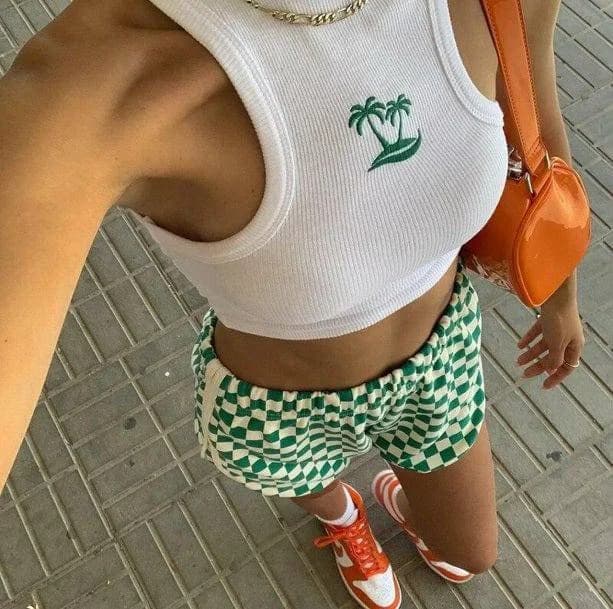
Two-piece sets give you multiple styling options with minimal planning. The Y2K Checkered Shorts & Top comes in green or brown, allowing you to wear both pieces together or split them up. You might pair the patterned shorts with an oversized layer from Oshare Kei Hoodies for a relaxed, balanced daily look.

How to shop for it without overspending
Oshare kei is easy to overbuy because everything looks fun on its own. A little planning helps you end up with outfits instead of a pile of one-off pieces.
Start with a gap check. Lay out your black basics first: tops, bottoms, a jacket and shoes. If you already have those, spend on the bright and playful parts. If you don't, buy a good dark base before anything neon, since it makes every other piece work harder.
Next, pick your two colors and stick to them for your first few purchases. If you choose hot pink and electric blue, every new item should work with one or both. That way a new tee, socks or case will pair with most of what you already have.
Then favor small, repeatable items. Socks, hair clips, cuffs, cases and gloves cost less than big statement pieces and show up in more outfits. Save bigger buys, like a bold jacket, for when you've worn the smaller items enough to know what you reach for.
Before you add anything to your cart, ask three questions. Can I make at least three outfits with it? Does it work with my dark base? Will I still be comfortable in it after a few hours? If the answer to any of these is no, wait a week and see if you still want it.
Finally, read the product page closely for materials, sizing and care details, and check the size chart against your own measurements rather than guessing from your usual size. Fit can vary between items, so it's worth the extra minute.
Keeping bright pieces looking good
Bold colors and dark pieces side by side can cause problems in the wash if you're not careful. A little routine goes a long way.
Read the care label on each item and follow it. Where possible, wash new bright pieces separately or with similar colors the first few times, since you can't always tell how a dye will behave. Keep black and neon items apart until you're confident.
Turn printed tees and hoodies inside out before washing, which helps protect the graphics. Fasten any hooks or zips, and take off metal accessories so they don't snag knits or fluffy layers.
Store chains, studs and cuffs separately from soft items. A small pouch or box stops them from catching on your cardigans and socks. Keep socks paired as you fold them, especially if you wear bright ones often, so you aren't hunting for matches before you leave.
If a fluffy layer gets crushed or tangled, let it dry fully and handle it gently rather than pulling at it. And if you're ever unsure how to clean something, go with the gentlest method the label allows.